
When lean takes flight
How do you rate an airport? Do you look at the efficiency of the check-in process? The speed with which baggage is returned when you get off the plane? Do you assess the shopping experience or the ability to connect effortlessly to another flight? Do you take into account the proportion of lost baggage and the means of transport to and from the airport? Do you consider on-time takeoffs and landings? Whatever the criteria used by satisfaction surveys, one thing is clear: French airports rarely rank well.
Agnès Nicolas, head of lean at Orly airport, south of Paris, decided in early 2018 that on-time departure was the indicator the airport should focus on every day. After all, that is what airports do: ensure that airlines fly safely from one place to another at a set time, and weather conditions or the heavy traffic of the most visited country in the world are no excuse from the passengers' point of view.
AGREEING ON WHICH PROBLEM TO SOLVE
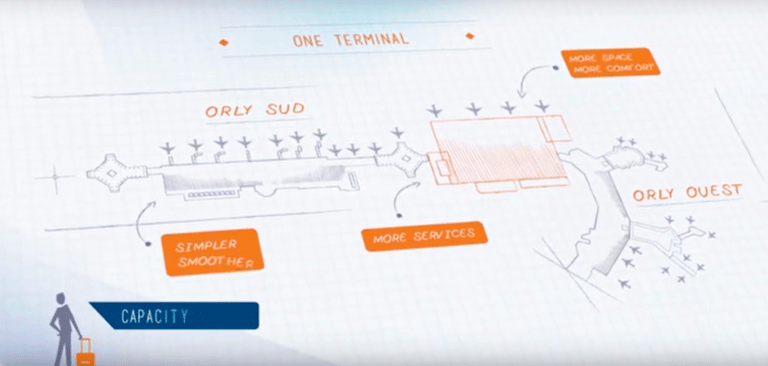
ADP (Aéroports de Paris) recently launched a major renovation of its Orly facilities – with a terminal expansion and improved rail connections to central Paris, with an eye on the 2024 Olympic Games. The investment comes late for an airport that opened to commercial traffic in 1946 and saw its status as France's number 1 airport usurped by Roissy Charles de Gaulle (located north of the French capital) from 1974 onward. This major investment will bring significant organizational changes, with the two terminals (Orly South, which covers southern Europe and Africa, and Orly West, which covers domestic traffic) being combined to harmonize the quality of service to passengers, provide a single point of entry for airlines and reduce costs through synergies.
For Agnès, the context was not ideal: such a big change comes with the risk that management's attention will be diverted from passengers as day-to-day operational concerns take over.
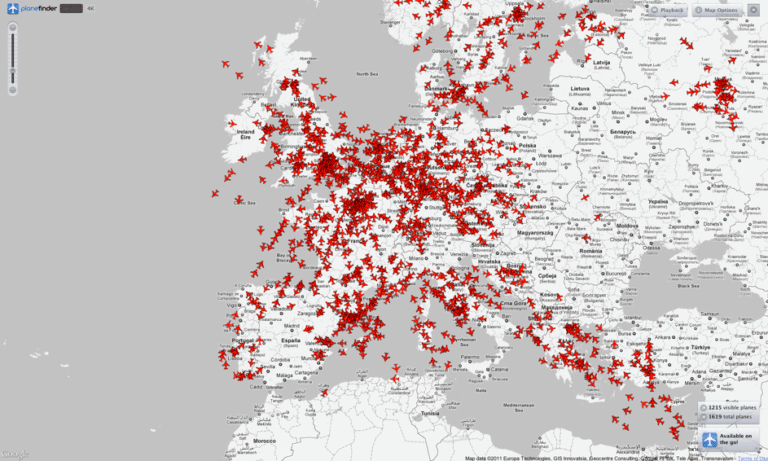
Another concern of hers was the common idea that delayed departures were mainly caused by excessive air traffic. Research, however, indicates that this accounts for only 15% of the delays recorded in Europe. The average departure delay in Europe was 11 minutes in 2016, with France accounting for a third of all European delays. This is partly explained by France's geographical position at the center of Europe and by the fact that every year the country receives a very high volume of tourists. However, a simple look at a flight-tracking app reveals that the center of European air traffic lies further north. Consider also that a one-minute delay costs an airline between € 80 and € 100: multiply that by the 11 minutes of average flight delay in Europe and by the number of flights airlines operate every day, and you will quickly reach millions of euros.
Agnès decided to stick with her idea of improving on-time departure and convinced the Executive Committee to try a pilot project to investigate the causes of delays and learn from the experiment. The partner selected for the pilot was a new low-cost airline called French Bee (IATA code BF), and the route chosen was Paris-Réunion (300 to 400 passengers per flight). The goal was to consistently improve the 16-minute punctuality of this route from 42% to 85% (this indicator was around 18% in early 2018). 16-minute punctuality means that if planes leave the boarding gate at H+16 min (where H is the scheduled departure time), there is no delay, whereas if this happens at H+17 min, it counts as a delay.
GENCHI GENBUTSU
Now, how do you improve punctuality? You start by walking the gemba and breaking down the different steps and the risks associated with a delay.
Check-in -> Baggage drop -> Security check -> Border control (if required) -> Boarding -> Taxiing
Agnès and I get ready for the walk, which starts in the check-in area. Check-in for that day's 16:30 flight should close soon, and Agnès frowns, as do a dozen passengers who are still in line. “This doesn't necessarily mean we're going to be late, but it's not an encouraging sign”, she says.
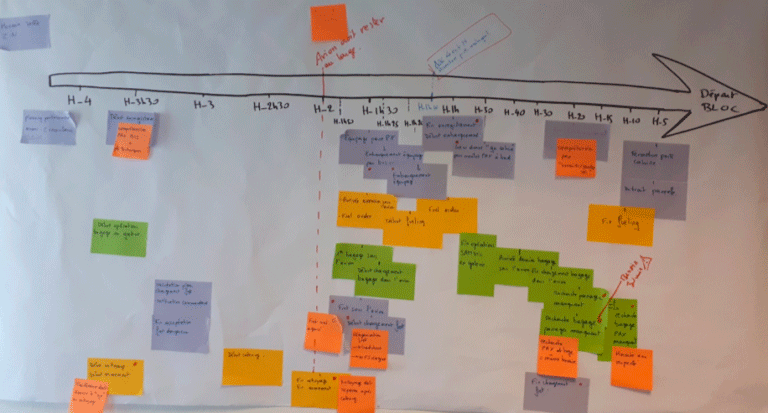
The first attempt to lay out all the steps along a timeline starting at H-4 (4 hours before taxiing) didn't work, Agnès recalls. Mathematically, there was no way the plane could be ready to leave in four hours. The plane would simply never start on time the way the tasks were initially represented. It took some time to gather all the data and fix this.
As we go through border control and walk toward the gate, Agnès tells me how they began their genchi genbutsu. Clearly, small wins were needed to gain people's trust and bring everyone on board. It took a bit of nemawashi to visit each stakeholder and collect frustrations and suggestions from each of them. The 2 main topics raised were the information process among the main players (times, gates, etc.) and missing passengers (those who check in but don't reach the boarding gate on time). If they check in with baggage and don't board, this adds a delay, because the baggage must be removed from the plane for obvious security reasons.
As the team investigated the details of the first topic, it soon found that the information and signals needed for a plane to take off on time are a permanent source of frustration and misunderstanding. This stems from the fact that Orly provides the infrastructure, but the actual check-in, maintenance, cleaning, police and boarding activities are outsourced to a large number of partner companies – not to mention the airlines themselves. When ADP (the airport) talks to French Bee (the airline) about check-in, they must include GEH (the airline's ground handling company, in charge of check-in and boarding), which in turn has outsourced baggage and flight coordination to SAMSIC. With different partners come different systems, Excel spreadsheets and forms. Signals can be confusing or even wrong (for example, the plane should be at gate 1, but it's at gate 2).
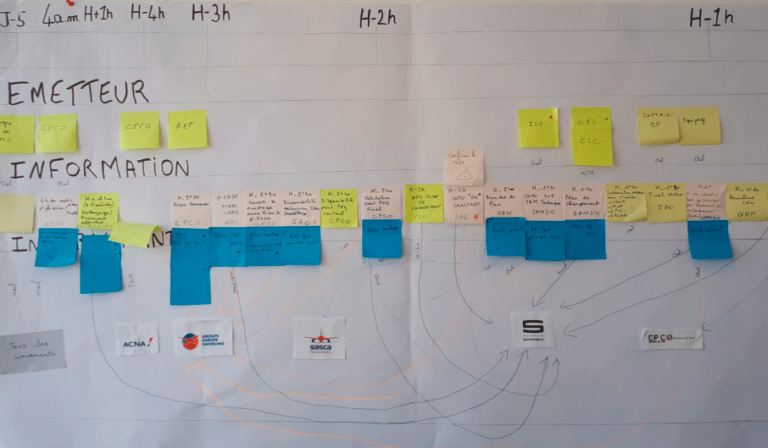
This led to a full 5S exercise on the information process (for example, adding people to mailing lists or clarifying details about which information needs to be shared), but also to additional communication by phone, since most information is passed on orally.
For missing passengers, the first assumption was that people checking in at the last minute were the main source of the problem. As a countermeasure, the last batch of checked baggage would only be loaded once the owners had boarded the plane. But Agnès was not fully convinced that this was the real problem, and the team decided to go to the gemba and ask questions. It turned out that missing passengers are more likely to be people who checked in early but were unaware of the boarding deadline (22% of respondents didn't know they had to be at the gate no later than 20 minutes before departure) or didn't realize how long it takes to walk to the gate (we timed it as we walked: the gate was 10 minutes from border control). Of those surveyed, 59% had no idea it took that long. Interestingly, 50% of passengers traveling out of Orly South are flying for the first time (a rate that is much lower at Orly West, where domestic flights are operated and business travelers are more frequent).
A first countermeasure to this twofold problem was to add a red sticker to the boarding pass indicating the boarding time limit. It worked: the number of passengers unaware of this limit fell from 22% to 4%. However, since French Bee promotes self check-in at kiosks, where boarding passes don't carry the red label, there is a risk that the current countermeasure is not a lasting solution. Discussions are under way to improve signage in the airport (“walking time to gate XX: estimated at 10 minutes”).
LEARNING FROM EVERY FLIGHT
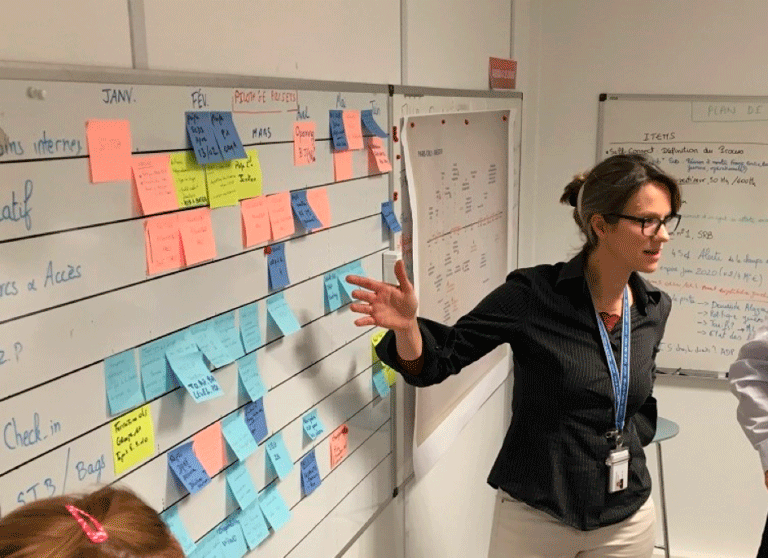
The team went through the list of problems and also worked on the logistics and sequencing of the different functions involved in the process (pushing the plane to the gate, maintenance, refueling, cleaning, etc.). If, for example, no machine is available to bring the plane from the parking area to the gate two hours before departure, that is a clear sign that the plane will not leave on time, and the only way to make up for the delay is to leave the plane where it is and take people to it by bus.
When we reach the gate, we have a great opportunity to see that – on this day – the rule is not being followed. The flight was due to take off at 16:30, and at 15:30 boarding has not yet begun. The crew hasn't even boarded (they should have done so at 15:10), because of the plane's late arrival. After investigating further, we are told that no machine was available to push the plane at H-2, but since they got one a few minutes later, they decided to push the plane to the gate anyway. Later, we find out that, although the rule was not strictly followed, there is no boarding delay.
At 15:50, the cleaning of the plane is complete. Boarding begins at 15:52 (38 minutes before the scheduled departure time, with 409 passengers to board). Twenty-eight minutes later, boarding is complete and no passengers are missing (probably the combined effect of the red stickers and the late boarding).
We go down the jet bridge to see the last passengers get on and watch the final details of the departure from there. Right in front of the plane's cockpit, visibly placed in the corridor, a board reminds everyone (including the pilot and the flight coordinator) of the departure time. There are 4 minutes left, but Agnès and her colleague Laure shake their heads. “Refueling isn't finished yet, and the pushback machine isn't in place. The plane won't leave on time. Any moment now, the flight coordinator will need to request a delay”, she says.
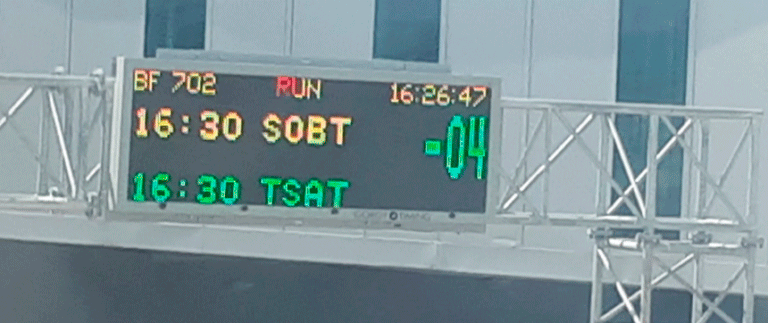
If no delay is requested, gate planning will be affected, and arrivals or upcoming departures will wait instead of being moved to other available gates.
Suddenly, we see a change on the control panel: a 15-minute delay is requested by the flight coordinator and lights up on the panel. It is soon accepted by the team responsible for the airport's gate allocation when the start-up approval time lights up. The flight will now leave at 16:45.
At 16:31, refueling is still going on. Carry-on baggage not accepted in the cabin is still waiting to be collected and loaded into the aircraft's hold.
16:41 – We see the flight coordinator going up and down the stairs, handing over the remaining carry-on baggage, checking some technical aspects on the ground. Now refueling is complete, and the economy class jet bridge is withdrawn. Will 16-minute punctuality be achieved? Unlikely, as some baggage is still on the ground and the pushback is not yet connected to the plane to start off-block.
16:43 – Another 10-minute delay is requested and accepted.
16:45 – A passenger is not feeling well, and medical assistance is being provided inside the plane. Should the passenger disembark or not? At 16:52, the passenger is escorted off the plane, as the precautionary principle prevails. 16-minute punctuality will not be met.
16:54 – The baggage loading ramp is removed, but the pushback is still not connected to the plane, revealing a new problem.
17:03 – A new delay is requested and accepted. The pushback machine moves toward the plane.
17:14 – The plane takes off 44 minutes later than scheduled, and Agnès sighs.
That's when we have the opportunity to talk to the flight coordinator to try to understand what happened (he has already spoken by phone with French Bee's director of operations, with whom the punctuality project was conducted).
It turns out that, in addition to the plane's late arrival at the gate and the sick passenger, the pilot decided to take 78 tons of fuel instead of the expected 73 tons (this is a decision for the pilot to make, as he examines the load and flight conditions along the route). This forced the flight coordinator to unload a cargo pallet to keep the plane's weight on target. But of course the selected pallet was not easy to reach, and it took a while to shuffle and sort things before this could be done.
SOLVING PROBLEMS ONE BY ONE
Every flight will have similar small problems to solve. Overall, French Bee's 16-minute punctuality on the Paris-Réunion route has already improved from 18% in early 2018 to 78% in March 2019. But to move forward, a systematic analysis of the real causes of every flight delay would be needed. The causes of delay are tracked in flight reports, but they are often disputed (“don't blame me”). Other times, the reports show only the last apparent cause (in our case, the time to unload a cargo pallet). Unless an analysis happens immediately (jidoka), it is very difficult to investigate root causes based solely on the information provided in official reports and to act on them (in our case, an interesting improvement path would be to reduce uncertainty about weight and at least anticipate the need to adjust it at the last minute).
So Agnès is now thinking about the next step.
Should they continue driving improvements carried out by a project team? As such, they can only deal with recurring cross-functional issues. But, given the other challenging priorities at the airport mentioned above and the organizational changes, it is hard work to bring all the functions together regularly.
What about handing punctuality improvement over to those who see an on-time departure as a key measure of success, in this case French Bee? Project-based kaizen is rarely sustainable: the only way to improve continuously is to involve everyone in the daily improvement of delivery, supported by jidoka and short PDCA cycles. And, by the way, how would jidoka work in the case described above? Certainly not with airline supervisors summoning, at the height of the crisis, their outsourced resources (such as the very busy flight coordinator) to understand what is happening. But by observing the gemba and analyzing the facts, so as to support the standards of who does what, in which scenario, such as those progressively revealed, which are designed to save time on each flight's departure. And, since the various steps of flight preparation from H-4 are now known, pull flows and kanban cards, providing clear signals about the next or missed steps, can also be the way to improve visual management. Certainly this is not easy to implement in the corridors (digital tools can help here), but it is a sure path to on-time delivery and, furthermore, to agreement on which problem to solve next.
Another idea would be to launch a community of practice, to get a group of flight coordinators and check-in/boarding staff to share their experiences, learn from one another and develop skills.
As we walk toward the exit, Agnès tells me the story of a European airport that made on-time departure a company-wide challenge. Its ranking soared, and its rating in the ACI surveys improved considerably. She firmly believes that Orly can do the same.