Eliminating artificial sales peaks
Markets behave in erratic and unpredictable ways, always generating variation in production volumes and mix. The causes are linked to factors such as changes in economic growth cycles, product life cycles, seasonality, etc.
However, there is a variation in sales whose level swings dramatically over the weeks of the month, in some cases concentrating as much as 70% of sales in the last week of the month.
This article presents a sales leveling method to reduce artificially generated sales variation, known as “created demand,” in order to avoid overburden and idleness in supply chain operations. “Created demand” is an artificial demand, often created by the company itself to unload product inventory through temporary promotions, generating artificial peaks and valleys in sales.
In the first part, we suggest reflecting on the company's current sales strategies and practices, in particular by understanding the flow of information. Next, we present the method for leveling sales and reducing artificial fluctuations. With this leveling method, companies will make better use of their resources and their customers will be better served.
I. Understanding the current information flow
To apply the leveling method, it is necessary to analyze how the information originating with the end customer is transmitted through the supply chain, summarized in the following questions:
What is the real consumption behavior of the end customer?
This question goes beyond the primary customers, served directly by the manufacturer, and must be directed to the end customer (who consumes the product). The analysis of real consumption can be carried out using sales data from the primary customer or by collecting data directly from the end customer.
In most companies, this data is not available, which requires a data collection effort, in which the most relevant data are: sales volume and frequency (to identify whether there are concentrated peaks), with sales volume percentages at least on a weekly basis.
The results frequently show that the end customer's consumption behavior is different from sales behavior, as shown in figure 1. This type of effect that occurs in the chain is known as the “Bullwhip Effect,” the result of artificial oscillations propagating throughout the entire chain.
Among the causes of this effect are:
- Sales incentives through promotions aimed at distributors rather than end customers
- Promotions that do not stimulate long-term growth
- Manufacturer discounts at the end of the month to reach targets
- Customers buying in advance
What are the current sales strategies?
Sales strategies can mistakenly incentivize salespeople and customers (primary and end), offering large discounts for orders above real need. Among the most common are:
a) Monthly target policies for salespeople, which encourage great efforts concentrated in the last week rather than continuous effort throughout the month;
b) Discounts for large orders, often compromising the profit margin;
c) Promotions focused on the primary customer, stimulating large peaks.
These strategies systematically stimulate irregularity (peaks and valleys) in sales, increasing the bullwhip effect in the chain and consequently costs. In addition, they make demand predictability impossible, since the peaks and valleys cannot be forecast, causing forecasts to have a very low level of accuracy.
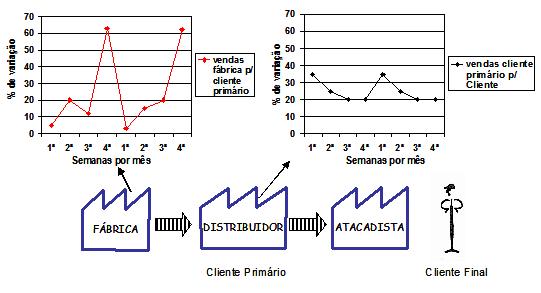
Figure 1 – Sales behavior of the plant and of the primary customer
How are sales forecasts prepared?
Companies generally have a systematic process for preparing the sales forecast, which is led by the Sales department. The parameters used to prepare the forecast are usually: budget, market share, sales history and customer forecast, often following this order of priority.
This means that the company is concerned first with the previously established budget and with its market share targets, and only then takes into account the customer's sales history and forecast.
Another important factor is the sharing of information with other departments of the company, in particular with Production Planning and Control (PPC); this happens in one direction only, that is, from Sales to PPC, which does not create consensus between the areas.
Demand forecasts are usually extremely optimistic, and when deeper questions are asked, it becomes clear that there is no consistent action that will stimulate real demand to increase as forecast.
The forecast is important information for supply chain planning, but it is not the only information that influences demand behavior. The way information about the order is transferred from one company to another, or between departments, can generate demand oscillations.
What steps does the order go through from the end customer to delivery?
The transfer of information between companies and departments happens in an obscure way that is difficult to see; for this reason we suggest identifying the information flow through the use of the Value Stream Map.
This tool makes it possible to identify the steps the information goes through and their associated waste. Orders are often transferred between companies in large batches, often at the end of the day or the week, generating waiting and artificial oscillations.
Batch transfer of information is also found within the company, between the Sales, Logistics and Warehouse departments, as in the example in figure 2. When information moves in waves, it ends up overburdening product picking and shipping, increasing logistics and warehousing costs.
This happens when the company determines that orders are to be sent to the warehouse at the end of the day; this forces the warehouse to have a large workforce to pick the orders at night and to schedule many trucks for the following morning to dispatch what was picked. These peaks create an excess of labor, trucks and forklifts for one part of the day, while for the rest of the day there is an excess of these resources.
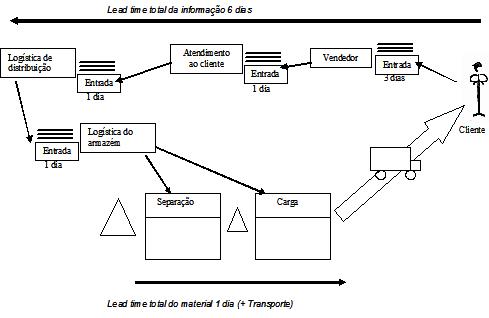 Figure 2 – Order Flow
How are salespeople encouraged to sell?
In some companies, the actions that serve as incentives for salespeople are extremely focused on selling at any cost, even if this means losing margin or, in some cases, overstocking the customer. This work logic is based on a short-term view: the most important thing is to sell (push) to the customer, which creates a difficult relationship with little integration with the customer.
This incentive leads salespeople to worry about placing orders for the customer, even if the customer does not need the product, instead of trying to understand, together with the customer, why the product did not sell, and what resources (product knowledge, joint promotions, etc.) the customer needs to increase those sales.
In summary, the questions for understanding how information is transmitted in the supply chain are the following:
- What is the real consumption behavior of the end customer?
- What are the current sales strategies?
- How are sales forecasts prepared?
- What steps does the order go through from the end customer to delivery?
- How are salespeople encouraged to sell?
The answers to these questions will lead us to reflect on and understand the real behavior of sales, how we affect this behavior and what the main causes of “created demand” are, always based on data. From there, we propose a sales leveling method to reduce artificially generated sales variation.
II. Implementing Sales Leveling
Before starting any sales leveling initiative, manufacturing must have achieved a minimum level of stability in its processes. Without this stability, sales leveling initiatives will not succeed, because manufacturing will not be able to respond to real variations in demand.
Reducing these artificial variations is possible through leveling, which means distributing information, product or sales evenly over time. The concepts presented below aim at leveled sales as a result, assuming that demand for many products is relatively stable but frequently disturbed by the production and sales systems.
The method proposes a significant change in the company's sales system, and therefore requires the involvement of senior sales management as the project sponsor.
Implement a pull system starting from your customer.
A pull system is made up of a supermarket that allows the customer to withdraw the product and signals, through a kanban, the need for replenishment by the supplier.
A supermarket is divided into cycle stock, buffer stock and safety stock (Smalley, 2004), and its sizing must take demand behavior into account, identifying the end customer's consumption behavior and the manufacturer's replenishment frequency.
This system allows real consumption information to be transmitted through the supply chain, avoiding the artificial oscillations generated by false demand. Replenishment is automatic: the customer consumes and the manufacturer receives a signal to replace what was consumed. In this way, Sales cannot push products to the primary customer unless the kanban signals the need.
Implement policies that encourage growing leveled sales.
Implement a sales target policy that distributes targets throughout the month (biweekly or weekly); in this way sales efforts will be distributed, avoiding large peaks in the last week.
Discount policies also cause uneven sales, stimulating one-off purchases that differ from real consumption. Implement policies that reward customers who place regular and growing orders, thereby encouraging growth and leveling. This strategy should focus on the primary customer's sales and not on its purchases, because when the customer sells more, it ends up buying more from the company as a consequence.
Prepare a more realistic and feasible sales plan.
Preparing the sales plan is crucial for good sales leveling, and it should be prepared by prioritizing the primary customer's forecast and history, which are a good initial reference because they reflect the real behavior of the end customer.
Another fundamental point in preparing the sales plan is to create a two-way communication channel with PPC, which should contribute to the plan by establishing manufacturing limits and pointing out alternatives in advance, avoiding additional costs and building consensus on what the sales plan associated with the production plan should be.
Based on this plan, Sales should establish the Takt Time, which is defined by dividing the available time by the forecast demand. Takt time is the common denominator between Sales and Production; it represents the pace of sales and should set the pace of the company's production.
Implementation of takt usually begins in Production, where defining it is the responsibility of PPC, but in essence Sales should take responsibility for defining it, mainly because Sales generates the demand figure that makes up takt time.
Takt time should permeate the entire organization and also set the pace of support areas, such as shipping, logistics and sales. In these cases, the activities of these areas usually do not have a constant pace; there is always a tendency to accumulate information and send it all at once, giving the impression that this is more efficient.
Implement leveled continuous flow of information
Sending orders continuously allows product picking to happen throughout the day, as well as truck loading and dispatch of loads. This initiative allows an even distribution of resources, avoiding overburden and waste.
In this way, it is possible to define the pace of product picking through the takt concept, taking into account the demand forecast by sales. An example would be to estimate the number of orders in the day and the available working time in shipping, which would give us: takt time = 480 minutes / 80 orders = 6 minutes per order.
Every 6 minutes the customer places an order, that is, we must have a process capable of picking one order every 6 minutes in shipping. With this reference we can see the waste that must be eliminated to make this pace in shipping possible.
Create a compensation system that encourages leveled sales
The leveling method requires a change in behavior on the part of salespeople, starting with the implementation of the pull system, in which order placement becomes almost automatic, so the salesperson no longer plays the role of order placer.
On the other hand, this forces salespeople to change their stance toward the customer, since they can no longer push products to the primary customer, indiscriminately increasing its inventory; they must take a proactive stance of helping the customer sell more.
This change is a major challenge during the implementation of this method, and for this it is important to create mechanisms that make the change possible. Reviewing compensation concepts so that they correctly encourage sales forces toward growing leveled sales, without loss of margin, enabling a long-term relationship with the customer, is a challenge that is the responsibility of senior management.
In the lean environment, the role of Sales must take on a new configuration, as the salesperson would increasingly become an analyst who understands the market and its variations, someone with deep knowledge of customer needs, a partner of the primary customer in increasing its sales, and an extension of the plant and of product development, passing on important information that enables constant improvement in the company's products and services.
To make sales leveling possible, in summary the company must:
- Implement a pull system starting from its customer.
- Implement policies that encourage leveled sales.
- Prepare a sales plan based on reliable information
- Implement continuous and leveled flow in the order flow
- Develop a compensation system that encourages leveled sales
III. Conclusion
Leveling sales is a challenge that companies must face to enable gains that go beyond Manufacturing, and the application of the method presented by some companies is already showing interesting results in line with the lean principles of waste elimination, among them:
- reduction of sales stockouts
- reduction of inventory in the supply chain
- increase in the delivery rate
- increase in sales (an indirect gain due to product availability).
Table 1 - Comparison between traditional and leveled sales behavior
|
Traditional |
Leveled |
Sales behavior |
- Irregular with large peaks and valleys |
- Regular with small variations |
Sales Strategy |
- Monthly targets |
- Weekly targets |
Sales forecast |
- Unreliable information |
- Reliable information |
Information (order) |
- Processed in batches |
- Processed in flow |
Salespeople |
- Order taker |
- Market analyst |
The concepts presented are simple, but they require discipline to implement, because the barriers encountered are enormous. Here are some recommendations for implementing the method:
- Select a pilot, define which distribution channel will start the project and choose a partner primary customer (it is recommended to identify one that already has a good relationship with the company).
- Understand the current situation: collect demand data, identify the real consumption behavior, identify the information flow, the current sales strategies and how salespeople are encouraged to sell.
- Identify the causes that generate artificial sales variations.
- Design a pull system with the customer.
- Set weekly targets for a pilot sales team
- Monitor the results, analyze and reflect on the process, adjust the actions if necessary, and develop an expansion strategy.
This is an important step toward the Lean Business System, but it is only a new stage of the journey whose objective is to make the company ever more profitable.
References
- Shook, J. and Rother M. “Learning to See”, Lean Institute Brasil, São Paulo- SP, 1999.
- Smalley, A. “Creating Level Pull”, Lean Institute Brasil, São Paulo- SP, 2005.
- Marchwinsky, C and Shook, J. “Lean Lexicon”, 2005, Lean Institute Brasil, São Paulo- SP