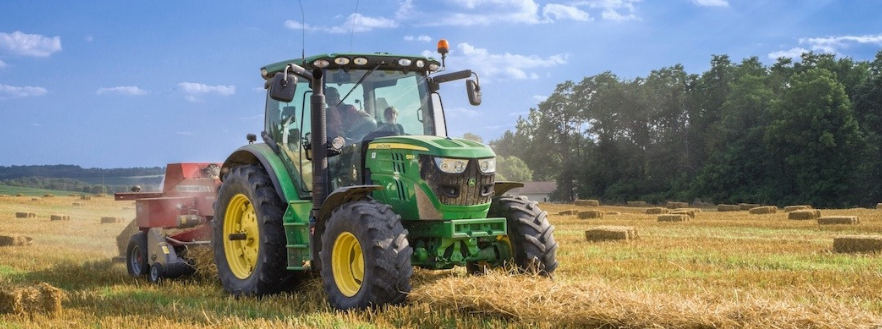
Agribusiness: a global paradox
Agriculture and farming face a global paradox: we produce enough food to feed everyone, yet we waste up to 35% of what we grow — a loss estimated at 1 trillion dollars a year. Moreover, the UN warns that if current practices continue, soil degradation will leave the planet with only 20 harvests remaining before a global collapse.
The problem is not technological. In fact, in many cases, machinery and biotechnology have already reached extraordinary levels of sophistication. The real gap often lies in the way farmers work: the absence of standardization, the lack of management systems and a farming culture that is still heavily dependent on intuition or capital investment — and far from the ideal conditions for developing people's capabilities.
The numbers confirm that the agricultural sector is characterized by a certain degree of imbalance: 84% of farms worldwide are smaller than two hectares, yet they control only 12% of agricultural land. At the other extreme, less than 1% of producers — mega farms with more than 1,000 hectares — control 40% of the land. While much of the world's food diversity and security is guaranteed by millions of small rural properties scattered around the globe (which should receive constant government support), it is the large agricultural conglomerates that hold the capital, the investments, the global market and the means needed to carry out large-scale production.
Regardless of the size of an agribusiness and its production volume, we know that wherever there are people and processes, there are opportunities for improvement. In fact, lean principles applied to agriculture are emerging as a powerful alternative to the traditional approach to farming — not a passing fad, nor just a set of tools, but a system that turns farm work into a discipline of daily problem solving and process improvement (reducing waste, increasing productivity and empowering people in the gemba) that spans primary production (crops and livestock) as well as the entire distribution chain, all the way to storage centers.
STRUCTURAL PROBLEMS IN AGRICULTURE
If we look at agriculture through the four lenses of processes, people, machinery and technology, we find that the problem points (pain points) are universal:
- Processes: low standardization, uncontrolled losses during the production phases, fragmented lots that prevent economies of scale, limited market access, heavy dependence on intermediaries.
- People: an aging farmer population and a significant generational transition, difficulty attracting and retaining people in rural areas, a low level of technical training or formal education, cultural resistance to change and, at the same time, hard and often exhausting work.
- Machinery: high-tech, high-cost equipment designed for large farms but unsuitable for small properties, electronic components that make repair service more specialized, reactive maintenance that interrupts production.
- Technology: uneven digitalization, poor connectivity in rural areas, scattered data that does not turn into actionable information for decision-making.
More than a lack of resources, agriculture faces a work management challenge: many critical activities are carried out without standards, without visibility and without the ability to respond in real time. In addition, leaders often fail to recognize their crucial role in providing clear strategic direction, promoting people development and setting an example day to day.
FACTORS IN THE CRISIS
The current crisis in agriculture is the result of multiple factors. At the structural level, land concentration has created disparities that favor large producers, while unbalanced margins and the overwhelming power of supermarkets and global traders leave farmers with little bargaining power. These pressures are compounded by cultural barriers, including a reluctance to cooperate or adopt new ways of working, excessive dependence on subsidies and a short-term mindset that undermines long-term resilience.
Operational challenges also play an important role. Variability in field practices, the tendency toward reactive maintenance instead of preventive maintenance and processes that remain disconnected from real customer demand limit productivity and adaptability. In addition, technology gaps persist, with many small farmers struggling to access reliable internet, modern machinery or financing — critical factors for competitiveness in today's agricultural landscape.
REAL-WORLD IMPACT CASES
The value of lean thinking applied to agriculture is rooted in practice. Around the world, results show that the impact of lean principles can be immediate, sustainable and transformative. Here are a few examples:
- Netherlands (Fruit and Seeds): over three years, a Kaizen project generated a return of €14 million in a well-documented case with more than 50 improvement projects (tracked and documented using the A3 methodology) generated during the project. Lean reduced operating space by 30%, ensured standardized processes and restored balance in the distribution of value. This kind of result is vital in a sector where supermarkets capture more than 50% of the margins, while producers receive only €0.025 per carrot, for example.
- Colombia (Manuelita Sugar and Energy): in sugarcane harvesting, 130 problems were identified — none of which required capital investment. The main cultural shift was moving from the belief that "improvement means investment" to the understanding that "improvement means building knowledge and capabilities through experimentation".
- Hungary (Dairy Farm): calf mortality was almost 5.3%. With simple visual standards for postnatal care (colostrum within the first hour, disinfection of the umbilical cord and recording of the time of birth), mortality was cut in half.
- Brazil (Sítio Barreiras): with 720 employees, the farm introduced an innovative system of 89 Basic Management Units (UGBs), each autonomous in its operations, problem solving and improvement experiments. In 2023 alone, 900 employee ideas were implemented (already 595 in the first half of 2024), all rewarded and turned into new standards. The message is clear: agriculture is transformed when everyone has the power to improve. The country also has many other cases in the production of grains, vegetables and other crops.
- Bulgaria (BG Agro): managing 15,000 hectares and €50 million in machinery, the company faced high costs from stoppages during harvest. Lean made possible the standardization of maintenance, the use of skills matrices and the reduction of downtime (downtime), significantly reducing the stress of the farming seasons.
- Africa (Zambia – Tilapia Farming): the critical challenge was the Feed Conversion Rate (Feed Conversion Rate – FCR), the main cost driver of the production system. An initial lean assessment revealed inefficiencies in the organization of the workforce and in feeding logistics, opening the door to significant savings per ton of fish produced.
These are just a few examples of the results and opportunities that lean thinking can bring to agribusiness. They show that lean is not limited to particular crops, geographies or scales of production — it depends, essentially, on the ability to observe, standardize and solve problems in the gemba (the farm).
OUR LEAN APPROACH TO AGRIBUSINESS
After consolidating global learnings, we defined a simple, replicable approach that can support companies and rural producers interested in leading a lean transformation in agribusiness:
Step 1 - Identify and solve problems: map processes, identify the main challenges and define key performance indicators (KPIs).
Step 2 - Daily management system: ensure visibility, visual boards, rapid problem solving and leadership that makes problems visible instead of hiding them.
Step 3 - Standardization and Capability development: define clear operating parameters, teach problem-solving methods and anchor improvements in standards.
Step 4 - Continuous improvement cycle: repeat the cycle until lean, through PDCA, becomes an organizational habit and not just a project.
This model turns agriculture into a living management system, in which productivity does not depend on buying more machines, but on strengthening the discipline of daily improvement in people.
WHAT WE CAN DO IN THE SHORT AND MEDIUM TERM
Short term (quick wins):
- In Step 1, we can map critical processes (for crop farming: planting, harvesting, post-harvest; for livestock: the processes of breeding, animal rearing, nutrition, pasture management, etc.).
- In Step 2, we can implement simple visual standards.
- In Step 3, we can establish daily management meetings.
- In Step 4, we can introduce an accessible suggestion system.
Medium term:
- Improve planning capabilities and their connection to business strategy.
- Spread the daily management system throughout the organization.
- Turn scattered data into actionable information.
- Integrate suppliers and customers into the lean system.
- Develop local competencies to sustain continuous improvement.
CONCLUSION: THE HARVEST OF THE FUTURE
Lean agribusiness is neither a recipe nor a set of tools. It is an invitation to turn agriculture into a living learning system, in which, every day, in every field or processing unit, people solve problems to create real value for customers, communities and the planet.
In the agriculture of the future, competitive advantage will not lie in the newest machines or the largest subsidies, but in the ability to turn work into a daily discipline of problem solving and continuous improvement, "harvesting" the best ideas coming from the gemba in order to keep moving forward.
Want to learn more about lean in agribusiness? Don't miss the presentation by Bruno Battaglia, head of the sector at Lean Institute Brasil, at Lean Global Connection 2025. Watch it here.
THE AUTHORS

The members of the Lean Global Network Agro Initiative. From left: Bruno Battaglia (Lean Institute Brasil); Juan Ruiz (Lean Institute Colombia); John Hamalian (Lean SE Asia); Agnes Antal (Lean Enterprise Institute Hungary); Sergio Caldeirinha (Lean Academy Portugal); Cevdet Ozdogan (Lean Institute Turkiye); William Luo (Lean Enterprise China).