

Lean Project Management; optimized use of resources ensures success in project management.
Luciana Cristina Pedrão - Logistics Planning Analyst at Toyota do Brasil
The use of lean concepts in production is already a well-known practice. However, their application in Project Management is a novelty that can bring countless advantages to companies.
In this article we carry out an exploratory study of lean concepts and their applicability to project management.
Every day more companies are adopting project management as a strategy to increase their competitiveness in the market, demanding more efficiency from organizations in delivering good results. And these good results come from the execution of projects. In recent years, it has become clear that using only Project Management best practices is necessary, but no longer sufficient.
The basic hypothesis is the need to optimize the use of the resources available in companies so as to achieve better results without large investments, through the elimination of waste.
The relevance of the study lies in proposing this resource management methodology, envisioning not only the elimination of waste but also the lean management culture, which results in an important tool to help companies in this new scenario of competitive demands.
Introduction
Within the new global competitive reality, a company that wants to prosper or even survive must seek up-to-date knowledge of the competitive forces that drive it and, as a consequence, develop a strategy that necessarily focuses on reducing costs and improving its processes. The potential of Project Management as a competitive weapon and the concept of continuous process improvement as a strategic asset can no longer be neglected.
A strategic approach to project management must necessarily regard the control of resources as a vital part of success. In this sense, applying lean concepts is a means of reducing waste and increasing efficiency in the use of resources.
The lean system takes a new approach to the use of resources. The true need for resources is the real, natural need, the one resulting from activities that add value. All other needs, arising from activities that do not add value, are in fact waste.
The term lean emerged in the business literature to describe the Toyota Production System. That system was lean for a number of reasons (WOMACK AND JONES, 2005):
- It required less effort;
- It required less human effort to design and produce vehicles;
- It needed less investment per unit of production capacity;
- It worked with fewer suppliers;
- It operated with a smaller quantity of parts in inventory at each stage of the production process;
- It recorded fewer defects;
- The number of workplace accidents was lower;
- It showed significant reductions in the time between product concept and its launch on a commercial scale, between the customer's order and delivery, and between identifying problems and solving them.
All of this always following the typical mindset of the lean system: which advocates the continuous simplification of processes and flows, setting aside the typical traditional thinking of "managing complexity," in which ever more complex information systems serve only to hide failures and shortcomings.
Lean project management has much in common with other lean concepts; however, the basic principle is to deliver more value with less effort in the context of the project.
Based on the strong arguments set out above and the pressing importance of the subject at hand, this article seeks to present the concept of lean project management; we will explore the origin of lean concepts and how they can be applied to the management of any project.
More than applying lean concepts, we offer results-oriented consulting for the services sector. We support your project management so that deliverables get off the drawing board with more fluidity, a focus on value and continuous improvement in day-to-day operations. Talk to our specialists and take Lean beyond theory.
Literature Review:
The term lean is directly linked to TPS (Toyota Production System). TPS is a manufacturing management philosophy that emerged in Japan in the mid-1960s, with its basic idea and development credited to Toyota Motor Company. The mastermind of this system was the company's vice president, Taiichi Ohno. The concepts of the lean philosophy were drawn from worldwide manufacturing experience and combined into a holistic view of the enterprise. The main concepts are independent of technology, although they can be applied together with technological advances. This new approach to manufacturing management arose from a strategic vision, seeking competitive advantage through the optimization of the production process.
(LIKER, 2004) says that TPS is not a toolkit; it is a sophisticated production system in which the parts contribute to the whole. The whole, at its base, focuses on supporting and encouraging people to continuously improve the processes they work in.
The term lean was popularized in the book "The Machine That Changed the World" (Womack, Jones and Roos, 1992), which clearly illustrated the significant performance difference between the Japanese and Western automotive industries. It described the main elements responsible for this superior performance as lean production, because Japanese business methods used less of everything: human effort, capital investment, facilities, inventories and time, in manufacturing, product development, parts supply and customer relations.
In the mid-1990s, lean principles left the shop floor and began to be used by companies around the world to manage different areas of organizations, and they became an effective tool for project managers to speed up activity cycles, controlling resources, reducing waste and increasing efficiency.
In "Lean Thinking" (Womack and Jones, 1996), the authors created five principles that were presented as a framework to be used by an organization to implement lean thinking, increasing the possibility of applying the concepts presented earlier. The initial premise is to recognize that only a small fraction of the total time and effort spent to produce a product or provide a service actually adds value for the customer. Therefore, it is essential to clearly define the value of a specific product or service from the customer's perspective, so that all activities without value can be eliminated.
These authors establish a set of five principles:
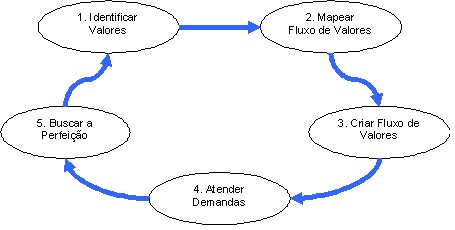 Diagram 1 – Five Principles of lean.
Adapted from: “WOMACK, J. E JONES,D., DANIEL,T., lean Thinking: Banish Waste and Create Wealth in Your Corporation, 1996.
The lean methodology, in short, consists of applying these five principles in cycles, always using the information coming from customers in the pursuit of perfection, with the goal of eliminating waste.
Identify value from the customer's perspective: the first step is to identify the value of the project or even of the task, because this defines its existence: should this be done? Does it add value for the customer? Is it necessary for the success of the project?
Map the value stream: make the flow happen without interruptions, check which resources are needed at each phase of the project, without allocating unnecessary resources and/or creating bottlenecks.
Take actions that create value flow: break projects down into small, easily manageable activities. Check the performance of those involved, identifying their strengths and allocating tasks so as to make the most of each individual.
Meet only the demands: do not decide on a path until those responsible for the project define which deliverables are needed. Involve the customer in the process, letting them define the needs and priorities. Decide late, deliver fast.
Seek perfection: develop people capable of making decisions, who take responsibility and are able to reflect on the lessons learned from previous projects, promoting continuous improvement through clear communication.
To apply lean concepts correctly in any area, it is necessary to clarify the question of waste. According to (CHO, 2001), “Therefore the goal lies in eliminating all waste, eliminating Muda - No added value, Mura - No uniformity and Muri - Beyond capacity; eliminate every type of waste and every activity that does not produce added value. Wasteful action is not work.”
Evaluate processes from the customer's perspective. The main question is “What does the customer expect as a result?” (we consider the customer to be the next process, and ultimately the external consumer). From this view it is possible to separate the steps that add value from those that generate waste in the processes. The “customer view” can be applied to any manufacturing, information or service process.
(SHINGO, 1996) observes that all wastes must be analyzed and weighed because they are interrelated and are easily concealed by the complexity of a large organization.
Lean manufacturing consulting is the key to transforming operations, reducing costs and increasing the productivity of your production line. Start driving results today with agile and efficient management. Check it out now!
Methodology:
The methodology used for this article is basically theoretical and is based on bibliographic research; its objective is to broaden generalizations, analyze what has previously been studied on the subject and, finally, based on experience using the lean methodology, address how to apply lean project management in the day-to-day life of an organization.
Results and Analysis of Results:
The evidence shows that applying lean principles is very effective at eliminating waste in manufacturing terms, but it is also a philosophy that, when applied to the management of any type of resource, proves incredibly successful.
Practicing lean Project Management.
“If you have a project to be completed in one year, it seems to me that companies that do not consider lean concepts will spend about three months planning, and then do the implementation. But they face all kinds of problems after implementation, spending the rest of the year fixing them. However, with a project to be completed within the same one-year timeframe, Toyota spends nine to ten months planning that project, implementing it little by little – with a pilot production – and implementing it fully at the end of the year, with practically no remaining problems.” (Alex Warren, former Senior Vice President of Toyota Motor Manufacturing Kentuck)
Choosing lean
Most project managers decide to use lean concepts in constrained situations, mainly related to deadlines and costs. One of the advantages of a lean implementation is that it requires no investment in technology and not much training; thus lean is an option to be used in recovering critical and/or troubled projects and in emergency situations. The lean methodology can be implemented at any phase of the project, as it concerns only the way activities are managed, with a simple, standardized approach that brings quick answers:
With the application of lean we have:
- Successful projects (satisfied customers and project team, scope met, on time and on budget);
- Speed in completing the project;
- Easy project tracking;
- Reduction of unnecessary documentation;
- Clear signals about when to make decisions about the project;
- Less pressure on project team members;
- Reduction of the waste that causes project delays.
Lean project management differs from others because it breaks the whole into smaller activities, improving delivery opportunities and increasing the level of satisfaction of the customer and the project team.
Dynamics of the lean methodology.
To outsiders, some elements of lean project management may resemble agile project management strategies, in which participants accelerate the project cycle to the point where planning and execution happen almost simultaneously. The principle of lean project management differs from the agile methodology precisely in that it devotes more time to planning, only moving on to the execution phase after the analysis and alignment with stakeholders have been completed; in this way the lean methodology minimizes rework.
During the first four phases of the project cycle, the lean methodology requires an enormous amount of restraint. Most project managers tend to want to show results at every opportunity; however, this can set them up for failure. Instead of simply avoiding responsibility, lean project managers postpone delivery and increase planning time, refining the scope of their projects. During the planning phase, project managers interact with stakeholders to align their expectations with the available resources and deadlines. In this way, managers avoid overpromising (promising more than is possible) and underdelivering (delivering less than expected); at the same time, breaking the project into smaller activities gives team members a strong sense of accomplishment and closure. This does not happen in traditional projects that stretch over months (or longer) and give teams a sense of dread, leaving them demotivated because they feel they cannot succeed. On the other hand, teams that complete smaller projects - even when part of a larger initiative - exude confidence and pride. By adopting lean project management strategies, leaders can keep their teams moving at a higher speed, making the work more dynamic.
Managing lean teams.
It is a common misconception for people to think that project managers manage projects. Project managers manage people. The main objective of applying the lean methodology to managing project teams is to create the ideal environment for employees, having the necessary resources available at the right time, supporting the activities. (Joe Taylor Jr., 2013) says that what sets apart a modern professional focused on lean project management is precisely the focus on the well-being of each team member. Lean project management eliminates waste in terms of time and resources; it does not eliminate people.
Team involvement in implementing the concepts is essential to the project's success, so the manager's role is to simplify and bring these concepts into everyday work, showing that everyone will benefit. In this way the lean philosophy leaves the manager's domain and is gradually absorbed and accepted by the team, thus generating an organizational culture geared toward eliminating waste and, consequently, more productive.
In most organizations, team members often have little notion of the project cycle or its relationship with project quality. Therefore, lean project managers must set aside a significant amount of time and resources to help team members understand the reasons for planning and for measuring success.
As a further impact on teams and organizations, reflections on success stories often encourage colleagues to embark on their own professional development exercises. The medium- and long-term effect of lean project management is to go beyond simply creating an efficient work environment. In fact, this mode of project management can cultivate exceptionally strong teams that generate high-quality ideas, bringing enormous professional fulfillment to those involved. When we reach this organizational level, we can say that we have a lean culture.
The lean Manager's Stance.
Before saying you can't do something, try it! Sakichi Toyoda
Providing strong leadership and practicing lean project management is still a challenge in many organizations. Some leaders cannot understand the benefits of dividing large projects into manageable parts, some corporate structures resist the flattening of organizational charts that can happen after a few lean project cycles, and some leaders may even feel resentful when they identify waste in their processes. To successfully implement lean project management in an organization, project managers must believe in themselves, believe in the process and stay strong.
One of the best ways for project managers to strengthen themselves, especially during the initial phases of implementing lean project management, is by promoting the positive impact of the procedural changes and publicizing the benefits of the methodology. Taking into account the interests of those involved and possible resistance, the manager must plan their actions so as to win the commitment of all stakeholders, making everyone feel part of the team and responsible for the change. After all, it is these people who will make the lean culture truly take hold and become a standard for project management within the company.
Conclusion
Looking at the big picture is the most important component of lean project management. Practitioners of lean project management refer to what they do as "seeing the whole." Lean project management offers company leaders a platform on which they can create a highly effective work environment that validates individual achievement, leaving plenty of time to plan and discuss. "Seeing the whole" also refers to the way project managers view the project cycle. Instead of rushing to reach the implementation phase, team leaders can appreciate the ability to set agendas to eliminate unnecessary elements from the project. Moving through the project cycle often opens up new opportunities to respond to customer demands, freeing teams from tasks that have little or no bearing on the project's success.
By following lean concepts and generating a continuous flow among Womack & Jones's five principles, project managers will not only be able to eliminate the waste that causes project delays and creates a stressful environment, but will also be able to create value for the business, positively impacting the company and the lives of the people involved.
Lean project management may not be suitable for every organization, every team or every project. However, for companies with strong leadership and a commitment to continuous improvement, this philosophy offers a solid foundation on which to build high-quality products and services
(CHO, 2001) “We care about the subsequent processes as customers, providing each one with the necessary dose of quality, products and services in just the right measure.”
The literature review draws on the contribution of the leading names in the mindset of lean concepts and philosophy.
References
LIKER, J. K.The Toyota Way: 14 Management Principles from the World´s Greatest Manufacturer. New-York: McGraw Hill, 2004.
SHINGO, S. O Sistema Toyota de Produção do ponto de vista da Engenharia de Produção. 2nd Edition, Porto Alegre: Bookman, 1996.
WOMACK, J. E JONES,D., DANIEL,T., lean Consumption. Harvard Business Review, March 2005.
WOMACK, J. E JONES,D., ROOS, D. A máquina que mudou o mundo. 14th ed. Rio de Janeiro: Campus, 1992.
WOMACK, J. E JONES,D., DANIEL,T., lean Thinking: Banish Waste and Create Wealth in Your Corporation. Simon & Schuster, New York, 1996.
Joe Taylor Jr., http://www.brighthubpm.com/methods-strategies/12769-principles-of-lean-project-management-empowerment-respect-integrity, 2013. Cho, Fujio. The Toyota Way. Toyota Motor Corporation, 2011.





