
Toyota's secret ingredient
In 2022, Toyota sold 1.12 million Corollas and 0.87 million Rav4s. By comparison, the Ford F-series sold 0.79 million and the Tesla Model Y 0.76. In total, Toyota sold 10.5 million vehicles last year, far more than the second automaker in the ranking, Volkswagen, with 8.3. And yet Toyota is in trouble - again. In fact, Toyota is always in trouble. It was a flop in the battle for the 100% electric vehicle and is now losing its lead. It is natural to ask whether Toyota is facing the fate that every dominant company eventually meets one day and will be defeated by its younger rival, Tesla. Maybe. We'll see. For now, the Corolla is still indisputably the best-selling car in the world.
For those who believe lean is the Toyota Production System (TPS) adopted outside Toyota, two hard questions need to be asked constantly: first, is TPS still the best business model available? Second, have we drawn the right lessons from what we see at Toyota and do we understand what TPS is?
TPS may not be the best business model forever - perhaps the “Tesla way” will eventually surpass it. But TPS is, so far, the only framework that can be studied and experimented with, and the only viable alternative to financial management (results appear by magic, operating costs have to be reduced by cutting budgets, and any unexpected event can be booked as exceptional expenses).
TPS is a learning system, which teaches us to constantly ask:
- Can we generate more value for customers?
- Can we stop defects as close as possible to where they are created?
- Can we reduce lead-times between order and delivery?
- Can we better balance workload and capacity?
- Can we engage people in studying their standards and trying small steps to make things better?
- Can we develop even more mutual trust between employees and suppliers through problem solving and by making sure systems work as they should?
Because these core questions complement each other, asking them shows that TPS is indeed a learning system. For example, I would not recommend trying to reduce lead-times without first looking at quality, and vice versa, working on quality is hard to do without the pressure of just-in-time.
Much has been written about TPS and it has been very well studied - but how does that relate to the fact that the Corolla is the best-selling car year after year? What is it that we see Toyota doing that we have not fully integrated into our thinking? Reflecting on the lean debates and experiments of the past decade, I can see a few points we tend to underestimate. I believe the answer to the questions above lies in them.
VALUE IS CUMULATIVE
First of all, it is all about products and customers. The purpose of any business model is to make better products that can be sold for longer and more profitably. It is very easy to get distracted by all kinds of operational issues and not see the elephant in the room (to walk around it, in fact): products and services have to beat the competition in customers' heads, hearts and wallets. Toyota's approach is unique. It does not look for the brilliant products that will dominate the market and sweep up all the chips. It carefully - meticulously, one might think - generates value for customers over several generations of products.
The Corolla has been the best-selling car worldwide since 1997? How can that be? Well, if we forget about the organization for a moment and look at the product, we can see that TPS has a defined framework for developing it: what value should it generate? What waste should we eliminate? Instead of starting from a blank page, they constantly ask themselves what additional value they should generate (considering current customers' tastes) and what customer pains could be eliminated (including price). As I write these lines, I ask myself: what am I saying that adds to what has already been written about lean? What waste should I eliminate? Should I really retell the steps of TPS every time? The Corolla sells because Toyota has systematically taken the pain out of the experience of driving a Corolla, and most drivers seek ease and safety rather than racing down the highways - as well as reliability and residual value.
DISCIPLINED MAINTENANCE, PRUDENT INNOVATION
Products and services are made and delivered through processes. Processes require both working systems and people trained to work as they should. Processes drift when tools are not sharp, parts are worn, dirt gets in, new materials do not perform as expected, etc. People, in turn, get confused, lose focus, do not know what they do not know, forget what they should know, have good and bad days, and change their minds about what they are doing and why.
The work environment changes daily and frequently presents new challenges. As a result, nothing ever works as planned.
A process is a sequence of dependent events that occur exactly as planned. In real life, this is a very rare case of how systems work. In a system, components react to one another, rarely as predicted. The more pressure you put on one element of the system, the greater the response of the others - often not what was predicted. A 20-year obsession with processes has blinded us to systems, which behave more like living ecosystems than like machines. The only concrete way to keep the system under control is to carry out daily maintenance, right away: checking that everything works as it should and correcting abnormal situations immediately. By doing this, you both keep the system under control and learn about it and how it works.
Most Toyota plants in the world produce on two shifts and do maintenance during the night shift. This makes complete sense, since the night shift is necessarily more expensive than the day shift and we all know the night shift is a world apart. However, we often fail to draw the deeper lessons from this practice: investing heavily in maintenance to create performance in work systems, and trusting these systems because we know them.
The first presentation on kaizen I came across,in the late 1980s, by Professor Masaaki Imaï, introduced kaizen as the frontier between maintenance and innovation.
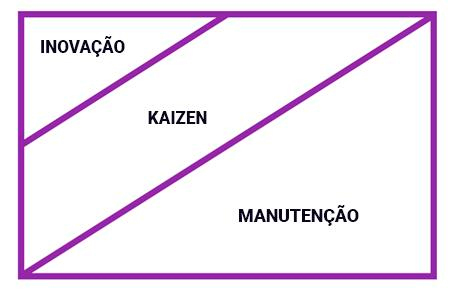
Society's current obsession with digital innovation makes us forget how profound the chart above really is. As a thought experiment, imagine our society if we had doubled investment in the maintenance of hospitals, schools, trains, or R&D over the last 20 years?
THERE IS ALWAYS TIME FOR A TEACHING MOMENT
If you exclude the die-hard Taylorists, who see lean tools as a way to perfect processes by imposing more detailed work rules on people (and there are still many of them), most students of lean have accepted that “to make products, we first need to make people” is the cornerstone of Toyota's paradigm shift. Even so, it is not easy to understand what this means in practice. It is hard to understand where Toyota stands now that it has become a large company. Its veterans, however, always remember the teaching moment when their boss would stop working to show them something, discuss, ask for a kaizen, or simply challenge the situation.
It is not as simple as it sounds. A few days ago, I was in a Steering Committee and a point came up that needed clarification and discussion, because it was central to the organization's mission - something everyone should understand and have an opinion about. It was not an easy discussion, because it was not an easy topic, but it was a learning conversation. Even so, the pressure to return to the agenda and decide on micromanagement topics was palpable. Prioritizing teaching moments over production moments requires real commitment.
First, it is assumed that the senior person has something to teach and knows how to do it - few jobs are designed this way. MBA programs teach people to optimize current processes and budgets so as to exploit limited activities now; they rarely prepare teams for tomorrow. Second, people have to be open to receiving instruction. For that, we need to think deeply about how the work environment makes room for readiness, encouragement of learning and deliberate practice (the three basic laws of learning, as identified earlier by researchers) - or not.
Teaching and learning as a key part of any job is a fundamental component of the lean worldview and requires some working theory of how to learn and teach. The predominance of the theory based on giving instructions/ checking execution (command and control) does not encourage learning and teaching time, nor does it encourage the understanding that connecting the dots rarely happens when you are focused on executing the work, but rather when you are interrupted by a new idea, from some other domain, or when you put two and two together differently from routine activities - which is the point of kaizen.
ALWAYS ASK: WHAT IS TRUE QUALITY?
“What is a good app?” “What is good service in a hotel?” “What is a good espresso machine?” “What is a good molded plastic part?” Quality is always taken for granted, because it is very hard to define. It is, however, what makes sense to customers and what customers ultimately look for and buy (it can also be different things for different customers or even for the same customer at different times or in different uses). Because the “quality question” is so open, we tend to close it by defining “standards”. With these standards defined, the question shifts from “are we doing the right thing” to “are we doing things the right way”. Clearly, in an ideal world, we want to do the right thing well.
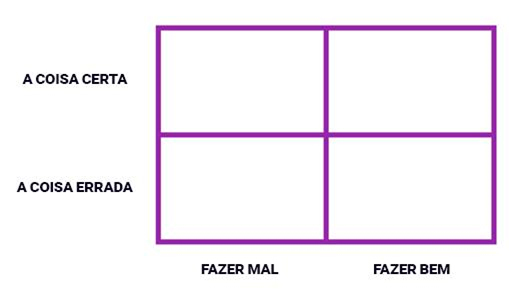
Because doing things well is easier to identify than doing things badly, managers tend to focus on solving that question and no longer think about doing the right thing or doing the wrong thing. All the more so because doing the right thing is usually hard, and therefore the tendency is to do it badly at first, until learning kicks in.
The point is that true quality lies in doing the right thing, not in doing the wrong thing well. The question of true quality is never closed: challenge product standards, challenge material and parts standards, challenge education and training standards, challenge tolerances, challenge instrument settings. Do these standards truly deliver quality to customers? Or do they serve to reassure the organization that everything is going well? The purpose of challenging standards is to investigate measurement methods and question the relative impact of quality characteristics against customers' opinions of the product until reaching consensus on defects and failures in the current production process.
The purpose of asking about “true quality” is to expose defects, pieces of work we think are OK but, in practice, do not work for the customer. To do this, we need to visualize the customer's own processes, see where, when and how they use our work and identify what helps them and what gets in their way. Be prepared: this will always be a hard discussion, simply because it is such an open question, and there are more mysteries than facts. Even so, one of the main secrets to making winning products is to constantly question quality standards and to discuss endlessly what, exactly, true quality is.
REVEAL REAL PROBLEMS TO DEAL WITH THE DIFFICULTY
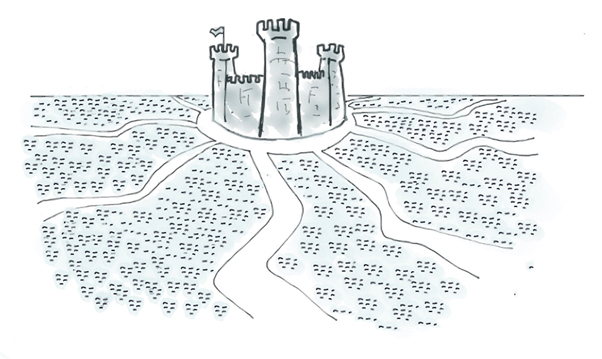
At the heart of every problem lies a real difficulty: physics will not allow a process, the machines will not have that kind of precision, someone will not do or does not know how to do what is expected, and so on. Instead of stopping in front of the difficulty, the purpose of problem solving is to bring it to the surface and then find a way to use it to do something different. Be creative. Come together and look at the situation in a different way and find a way around the obstacle. As Duncker's example shows, if the main road to the fortress is very well defended, find another path. Use the difficulty to discover what can be done differently.
Discussions about productivity tend to be difficult. Since Adam Smith's pin factory at the end of the 18th century, organizing has meant dividing work to benefit from specialization and avoid duplication of work, in pursuit of economies of scale through volume. This arrangement makes sense in stable situations where volume is guaranteed, but it is also terribly inflexible and produces a great deal of waste in terms of rework, inventory, backlogs,excess investment, and endless problems. Even so, it is useful for avoiding conflict by separating activities that are kept in different teams, departments or functions, so that everyone can produce without ever considering that, to use Kaoru Ishikawa's phrase, the next process is your customer and without worrying about what true quality means for the next customer as well as for the end customer.
Organizations avoid facing environmental changes or internal challenges through various defensive routines: they focus on secondary issues, to distract attention from “elephant in the room” issues and to avoid authentic conversations about doing the right/ wrong things. These defensive routines allow the organization to keep operating, regardless of whether it is working for the customer or not. It is not that organizations do not face problems, but that they choose the problems for which they have workable solutions - what used to be called the “garbage can theory” (an organization is a collection of choices looking for problems, issues and situations that can be aired, and solutions looking for problems they can answer).
Lean techniques such as kanban, jidoka or standardized work are all about revealing the real problem, the gap with respect to ideal delivery, to set the stage for genchi genbutsu: go and see, observe the real problem, listen to people in their respective contexts, build consensus on the real problem and gain commitment to kaizen. True kaizen is bringing value closer to the customer, which is hard because things are the way they are for some reason, and so we need to accept that for the team the difficulty is the path, the difficulty is the opportunity to understand in depth and find an alternative. Kaizen closes the gap between maintenance and innovation.
SHARE THE WINS AND GAIN TRUST
When I began studying Toyota's approach to engaging suppliers, I saw Toyota engineers going every month to visit suppliers' lines to help them improve quality, delivery and productivity (which makes sense in terms of maintenance and kaizen). Over two years of continuous improvement, the line boosted its productivity by 30% and achieved flawless deliveries through high flexibility (batches of less than an hour). Toyota never asked about this productivity improvement in price negotiations, and I wondered what the gain was beyond guaranteed delivery, which, let's face it, is worth much more in TPS than in other production systems. I discovered, however, that the work on the line led the engineers to redesign the product and the process for the next generation of products so as to achieve a 30% cost reduction! Toyota then shared the gain, keeping 15% for itself and giving 15% to the supplier. Imagine doing that with every product cycle?
This was extraordinary in two ways. First, Toyota's engineers knew where to look for the gain, and it was less about the evolution of the line's direct productivity and more about what could be learned from it for the next line. Then they knew to share the gain to build the trust needed to do the same in the next cycle. When I realized that trust was a fundamental element of the system, I began to see it everywhere in the way Toyota operates. At one point, the supplier no longer worked with Toyota. Even so, the Toyota sensei visited the line and held discussions with his apprentice at the supplier. “Why wouldn't I?” he asked me, baffled, when I asked him about it. Good relationships are more important than day-to-day business.
Trust is the fuel that makes the human engine run. You want to associate with people whose competence you trust, because you trust that they will do the right thing and succeed. You want to associate with people you trust to share the wins with you, who care about your situation and about what happens to you. Building relationships means both: finding gains and sharing them.
Trust is not merely a desirable human experience. It is central. Trusting that people have your back, trusting that machines work predictably, trusting that you understand how the world works and trusting your own focus to build the work of art that is your life. The whole TPS system is a learning system for building trust, with customers, with employees, with machines and plants, with suppliers, and for ensuring easier collaboration and flow, both in the work and in the psychological sense of intense engagement, focus and contentment in the present activity and the current moment.
IN ONE EQUATION?
So what have 30 years of discovery and experience with TPS taught us? What should we be trained to focus on deliberately every day to enrich our professional lives? If I had to sum it up in one concise equation, I would always keep these four components in mind:
- What is true quality for customers and how do we improve it?
- What is the path to improving true quality, with whom, and how do we learn together?
- What wastes slow us down that we should reduce?
- How long will it take to do this, and can we speed it up?
Or something like:
Improve true quality for customers X Find a path that builds trust through learning moments
Unnecessary activities and waste, such as rework or admin X lead-time to move on to the next steps
I realized that this takes us far beyond improvement processes that make parts move faster in the material flow, far from the mechanical view of organizations, but isn't that the real point of learning journeys? We certainly learn what we set out to learn, but how do we discover what we really need to learn? How do we take a step back and see that what we believe is limited by the questions we ask and by our narrow focus on what we were looking for in the first place?
What has Toyota really added to our knowledge of how to run organizations effectively, sustainably and responsibly? This is a harder question than it seems at first glance. I once had the opportunity to ask Mr. Takehiko Harada, who worked directly with Taiichi Ohno, what he thought the West had gotten wrong about TPS. “Our first objective was to develop subordinates,” he replied. “And we sought total optimization rather than partial optimization.” To learn, the student has to be ready to learn, which means we only hear the answers to the questions we have. To truly learn, we have to seek the questions that fit the answers we are offered.