Lean in government, a comeback?
When I ventured into the lean world more than a decade ago, I remember how the adoption of lean in government was on the rise. There were successful applications of the methodology across the sector and in many countries, mainly – as far as I know – in the English-speaking world, from Canada to the United Kingdom, from Australia to the United States. Then, after a few years, things seemed to go quiet. The experiments continued, of course, but perhaps not on the same scale as before.
That is why I was so happy when, a few weeks ago, my colleague Oriol Cuatrecasas invited me to a Lean Day held at the Department of Territory here in Barcelona. This department oversees public works and infrastructure for Catalonia, in northeastern Spain.
The Lean Day is an event I know very well. Organizations that have worked with the Instituto Lean Management use it regularly to bring people together to learn about their colleagues' improvement projects and celebrate their wins. It is a fantastic way to spread knowledge about lean thinking and boost learning.
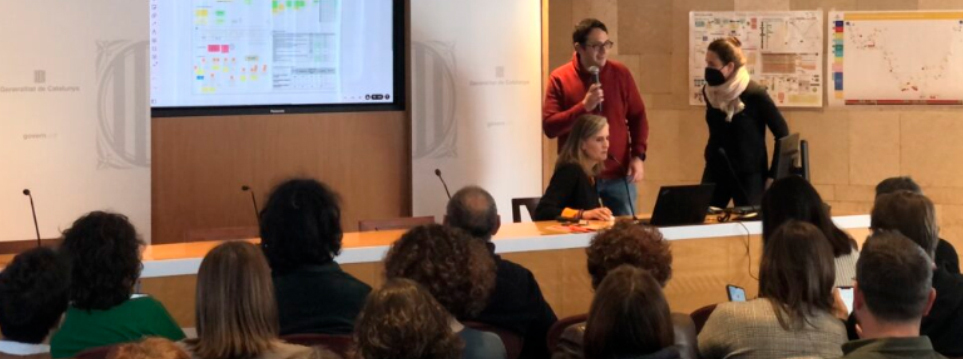
I walked into a room buzzing with activity, with about 50 other people present (plus 27 connected via the web). After a brief welcome from David Prat, Director General of Mobility Infrastructure of Catalonia, Project Director Anna Bullich, who oversees the lean implementation in the department, shared a brief explanation structured around the 3P model (which is an excellent way to know that a person is a lean thinker without them having to say they are a lean thinker…). The team's goal with the lean transformation is “to grow and transform” (the purpose) through continuous improvement (the process) and to develop the capabilities of its people. So far, six teams have received lean training and, as part of it, were asked to complete an improvement project.
The Lean Day was an opportunity to share this experience with others. Needless to say, they did it using the A3! The institute's approach is based on teaching people to use a few important lean tools, rather than the whole set. This was clear in the presentations, which showed many value stream maps, spaghetti diagrams and the 5 whys, for example.
One after another, the teams had the chance to explain what they had worked on and what learnings they had been able to draw from their experiments. Each was at a different stage of progress, but all used the same discipline to compile information, map their processes and think about the causes of problems and the related countermeasures.
The six projects presented vary widely in scope:
- Simplify the evaluation of bids to ensure a contract is awarded within two months, so that services reach citizens faster.
- Save time in reviewing project proposals by creating a standard practice for the review and setting priorities for which proposals should be reviewed first.
- Reduce the processing time for incorporating a public asset into the property register, aiming to complete it and issue a report to the applicant within three months (15 days if the process is not a prerogative of the Generalitat).
- In minor contracts, optimize three processes with little added value and high costs (due to their duration). Here the goal is also to cut costs in half.
- Respond more quickly, in 21 days (down from the previous 49), to requests for authorization to build along the roadside, where construction restrictions usually exist.
- Speed up the process of installing traffic signs warning drivers that they are in an area where animals frequently cross, from 10.4 months to 6 months.
After each presentation, Oriol Cuatrecasas shared a few words reflecting on the project. Each time, he extrapolated a learning from the team's experience that could guide future experiments. Following the tendering projects, for example, he explained how their success was the result of the team's focus on small improvements, rather than on one big problem or on many problems at once. A valuable lesson for everyone!

Before voting for the best lean project began, the audience had the chance to hear about the lean transformation of 365 bakeries, one of the best lean organizations I have ever known. Headquartered here in Catalonia, 365 has been on a lean journey for more than 15 years, constantly changing its approach to making bread and pastries to improve the service it offers its customers. Agus Tena, Continuous Improvement Manager at 365, put it best when he told Lean Day participants that “every day, we have a new opportunity to change things for the better”.
I was curious to know what people working in a government environment thought about a lean example from the food industry. Ramon Calabuig, Use and Protection Technician on the road signage project team, told me that “when you see what 365 has achieved, it is natural to think that if they managed it with dozens of bakeries, why can't we with just documents? What an inspiring example!”.
Another team member and head of the operations section, Marian Fernandez, added that “many in government feel overwhelmed by the amount of work and think there simply aren't enough people to do it all. But it's just like at 365; the only difference is that we don't say we need a bigger freezer – just more staff. What we really need is to find better ways of working with the resources we have available”.
At the end of the presentations, everyone was invited to take out their phones and vote for their favorite projects through an online app. As the votes came in, the bars projected on the screen grew taller and taller – amid the applause of participants cheering for their favorite improvement. In the end, there was a tie between the authorizations project team and the animal signage project team. They took home a bag with some of the best lean books around – Managing to Learn, Toyota Kata, The Lean Bakery and Everything I Know About Lean I Learned in First Grade.
Asked to comment on the event, Conservation Negotiation Manager Jesús Uclés (from the winning traffic signs project team) said that “seeing other projects taught me that problems are common across the whole organization, but it also gave me inspiring solutions that can inform my ongoing improvement work. To me, it is clear that we are all working toward a common goal”.
Raquel Griñó, from the other winning team (authorizations), came from Tarragona to take part in the Lean Day. She echoed Jesús's sentiment when she said that “events like this facilitate interaction and encourage more and more people to talk and learn from one another, which really helps us keep improving the service we provide to the Catalan people”.
Every organization needs to improve, and we all know – no matter where in the world we live – how much government could use a little more lean thinking. That is why it was so good to take part in this Lean Day and see how lean in government is alive and well; hopefully this trend is on the rise again. Jesus put it best when he said that “lean seems made for public administration! The sector is made of processes and people and is known for having few resources. Learning to do more with what we have translates into more and better services for citizens, and that is our goal”.