
My lean training is over, now what?
One of my biggest responsibilities at Lean Institute Brasil is coordinating the PPFL (Lean Practical Training Program) course for industry. This course is certainly one of the most complete on the lean philosophy available on the market. However, even with the many concepts and practices consolidated during the training and all the guidance given to the mentees, many wonder: the training is over, now what? Will I be able to continue the implementation in my company? Will I be able to expand it? Will it be possible to spread “lean” and get everyone hooked on it?
Well, this question is not exclusive to the PPFL training. In fact, it comes up whenever we take any kind of course or training. Moreover, it's not something that can be answered with a simple yes or no. Actually, everything depends on what is done with all the knowledge and practices acquired over the course. It also depends on the support you'll have within your organization. After all, senior leadership is a fundamental part of building a company's culture.
But getting straight to the point: yes, it is possible and likely that you'll be able to sustain the improvements and expand the lean philosophy in your organization, as well as extend its implementation to different areas of the company. To do so, we need to understand the fundamental steps to keep the “learning from dying”.
To illustrate, in a more instructive way, what happens during the PPFL and what can (ideally) happen after it ends – so that the organization truly achieves its lean transformation –, we will now present the story of Otávio Bortolo, head of Quality Control and Continuous Improvement at Scholle IPN and one of the participants in the PPFL in the second half of 2019.
A story of sustainment and future potential: Otávio Bortolo on Scholle IPN
Scholle IPN is a multinational company with several plants spread across the five continents, including one in Brazil, more specifically in Vinhedo, in the state of São Paulo, where I work. The Vinhedo plant produces different types of plastic packaging used to store processed liquid and paste-like foods. Its flagship product is the Bag in Box, a type of plastic packaging that sits inside a box (or drums for larger volumes) to store, for example, beverages and processed fruit; another product line that is also important in terms of sales volume is the so-called cleanpouches and their sets of (injection-molded) caps and spouts, which are packages used to hold, for example, processed paste-like foods.
My lean journey began when Scholle IPN gave me a big challenge. As a company in a market with growing demand, Scholle IPN saw that it needed to do something to increase its number of lines over the next two years, but it understood that it was essential to absorb that demand without increasing the quality control headcount and without losing the level of quality achieved up to that point.
I immediately understood that there was a great opportunity in the challenge, but also that great care had to be taken with the area and with the changes that would be made in it, since any poorly thought-out change could cause a drop in product quality and the loss of important certifications already obtained by the company, and that would be a real disaster for me and for the company.
While studying and thinking about alternatives that could substantially help me at such an important moment, I thought of lean. Lean thinking had already been discussed at Scholle IPN for a few years, and in the manufacturing area some concepts and tools had already been introduced and implemented, with Daily Management being the best example of lean applied and working very well in the plant. In addition, there had also been some kaizen events, the implementation of standardized work for tests and machine setups, an attempt at A3, at 5S, among others. However, these concepts, which had been implemented little by little, still had room for deeper exploration and a greater understanding of the philosophy. The goal, then, was to study.
Knowing about the Lean Practical Training Program, I sought the company's support to take part and thus go deeper into the philosophy. I truly believed that lean could help me a great deal with this new challenge. With full support, I began developing my A3, with guidance from the instructors and project managers, using as its purpose exactly the problem that had been presented to me: increase capacity without increasing costs while ensuring quality.
In short, what happened to me during the course was a driving force for my sustainment and motivation after it ended.
1. First step: seeing the causes of the problems
After learning the first concepts and seeing the practices during the course, I began going to the gemba to really see how the quality testing processes worked day to day. Together with the team, we mapped the process steps of the main tests, and each analyst's steps were timed and drawn. We created a spaghetti diagram.
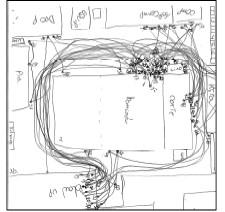
Figure 1: Spaghetti diagram of one hour of an analyst's work
This first step was fundamental. Together, the team and I could see opportunities we would never have thought of if we hadn't followed this first great concept: going to the gemba. Our observations were:
- The analyst observed never stopped walking at any time.
- The testing laboratory had grown very quickly, and therefore the tests had not been installed with a suitable layout in mind to optimize time and reduce each analyst's workload.
- There were many duplicated forms; that is, most were filled in by hand and then the person had to enter them into the computer, which generated 30 minutes of rework for each person, totaling three hours a day counting all the analysts and all the shifts.
Another analysis made possible by my going to the gemba concerned the tests performed during setups. We realized that each setup took an average of 13 minutes for all the tests to be performed and for the machine to start running. Each test was measured in terms of its duration and daily frequency. As a result, we found that the number of tests per month exceeded ten thousand analyses.
Based on this time study, we identified a major new opportunity to reduce the time of the tests that take a long time, and this would bring a double gain: in addition to freeing up people's time to absorb the new demand, it would reduce the setup time of each machine.
2. Second step: implementing the countermeasures
After our analysis, the idea was to optimize movement, eliminate the rework of doing the report twice and adapt the layout of the testing area. Whatever was easy to resolve was quickly solved, such as eliminating waiting before starting the tests.
Another example of actions taken concerned the assignment of analysts to machines. Previously, each analyst looked after three machines. Observing the layout and movement, and considering that each analyst only knew what was happening on their own machines, we mapped the opportunity to change the way this was done. Instead of each analyst looking after a fixed number of machines, the analysts would look after a fixed number of tests. Thus, the analyst on the upper level would handle only the tests performed there, going through all the machines, and the analyst on the lower level would handle the tests in that other part, also going through all the machines. See the new configuration in the figure below:
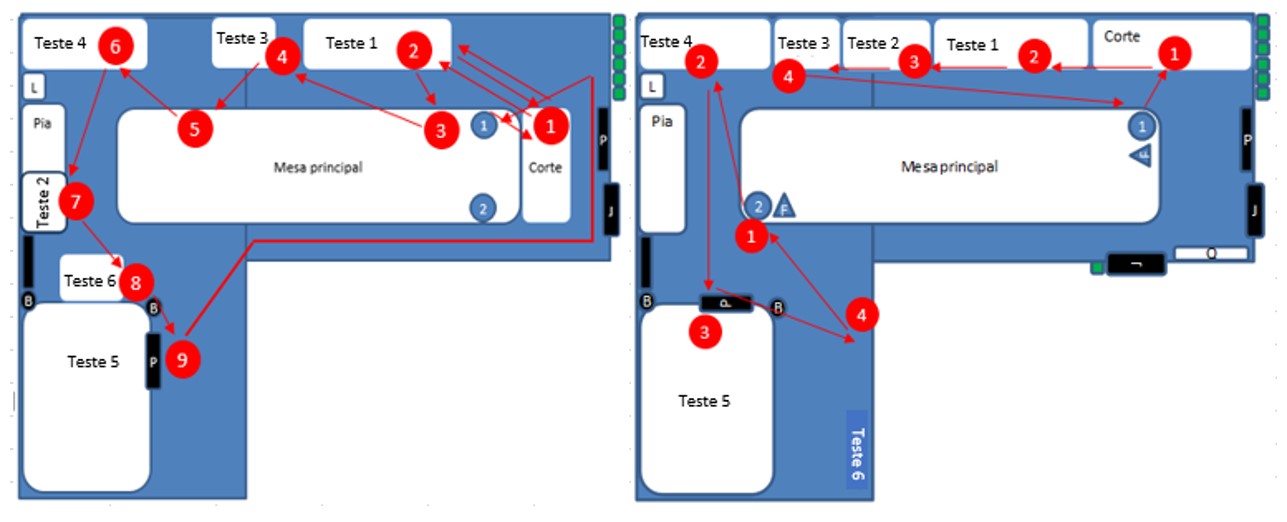
Some immediate actions were implemented right away, such as moving the door, configuring the layout and reviewing it as a whole; reviewing the requirements for the tests performed in accordance with the certifications and quality indicators; reviewing the operating method of the equipment; and reviewing the data control policy. Other, more time-consuming actions went into an execution plan.
3. Third step: reaping the results
With these simple actions, and without substantial additional costs to the organization, by the end of the training (end of 2019) we could already see many positive results:
- 42% time savings in the continuous data testing stage.
- 25% time savings in the functional testing stage.
In other words, we managed to achieve the objectives we had set for the purpose of my A3 while the course was still under way. Moreover, I could see that this was only the beginning and that countless improvement opportunities arose from there.
4. Fourth step: the tightrope of project continuity
I believe this is where many people's doubts lie, and it's also here that many people end up “getting lost” and letting lean die. When the training ends and you see the results achieved, you find yourself walking a tightrope and ask yourself: now what? Do I keep going? Can I do it? Or do I bail out?
From my experience, and from what I've seen of many PPFL participants at the end of the course, the answer I can give is “once you've caught the lean bug, it's very hard to go back”. Once you get to know lean concepts and practices, there's no way you can go back to seeing things, challenges and problems the same way as before. And that is one of the most important aspects that sustains its continuity.
Once the course was over, our next steps here at Scholle IPN were to expand and spread lean more deeply to other areas of manufacturing (production and warehouse), through training, people development and the implementation of A3 projects, getting the teams enthusiastic and involving them in all improvement processes so that they feel they belong and pursue the same goal.
We understood the need to go deeper and to bring A3 thinking to more and more people as a means of development. Nine months after implementing the opportunities mentioned, we are already finishing the implementations of the A3 I carried out during the PPFL and of the other A3s carried out internally in other departments (production and warehouse), and we are already thinking about a second round of training so that A3 thinking spreads even further throughout the organization. In addition, we have also started a Lean Office program so that we can implement the Lean philosophy in the office as well, something new for the organization.
The gains we achieved have continued and, with the optimization of some activities, we can already see a significant reduction in the time spent performing tests. As the final part of the plan, which will take place in October 2020, the paper test logs will be eliminated and new computers will be installed to ensure that entries are made directly into the system, eliminating the time spent on duplication.
Sustainment and expansion: Iris Bonfanti on tips for continuing the lean transformation
What's interesting in Otávio's story is that the actions they took while the course was still under way managed to achieve the stated objective and also brought new opportunities for gains and improvements. Besides that, this movement within the organization motivates many people at different levels to also embark on their own lean journeys, since everyone perceives the benefits for the company and for each of them in their day-to-day work.
It can be said that one of the biggest gains, in addition to the quantitative ones presented above, is the spread of the lean philosophy across various settings and hierarchical levels, and the perception that the improvements brought about by lean are beneficial in different ways for the individual and for the group.
The PPFL is a course unlike others because, in addition to teaching how to apply concepts and tools, it changes the way people see the world, business, and the way they work, manage and deal with the problems that arise. And that is something that will never leave you. That doesn't mean it alone is enough for a complete and sustainable transformation of the company. That's why we've selected some essential tips to help you continue your lean transformation as an individual and that of your company as a business:
1. Becoming lean requires study, discipline, resilience and depth.
For the lean journey to succeed after the PPFL, discipline and resilience are indispensable. Many things will give you reasons to give up… it isn't an easy task, nor a short-term one. We say that lean isn't a 100-meter dash, but a marathon.
2. Applying concepts and tools aimlessly, without relating them to the organization's purpose, doesn't make much of a difference.
Another very important thing is to always link the use of any tool to the purpose of the business. We always have to ask ourselves: which problem will this tool help us solve? By solving this problem, are we closer to our purpose?
3. The secret of lean is in practice.
Another tip that keeps lean from losing its spark after the PPFL is to practice, practice and practice. Lean can only be learned by doing. Don't be afraid of making mistakes. Try! The learning will certainly be enormous.
4. It doesn't matter at what scale you start. What matters is that you start.
Many start small, choosing a “pilot” that is significant for the business. That is perfectly fine. If well applied, lean will soon begin to expand and grow. Just start.
5. Don't try to find ready-made answers.
There is no ready-made recipe; there are no 10 steps to lean success. Create your own recipe based on your context.
6. Lean is about people.
Lean is socio-technical (in fact, it's much more socio than technical). So there is no lean if people don't take part in the change process.
7. Show the results to gain the support of senior leadership.
One thing that helps is showing how many benefits lean brings (if you can put a “value” on the gain, even better). What manager doesn't like results? And lean delivers results.