People power: adapting to changing times
In 1861, a Swede named Göran Fredrik Göransson figured out how to industrialize steel production with the Bessemer method. Almost overnight, the production cost of steel fell by 75%, and a multitude of new applications became possible. The quality of the material also improved dramatically, which allowed for sturdier and cheaper farm equipment. In turn, the mechanization of agriculture led people in Scandinavia to move to the cities, which resulted in a construction boom at the beginning of the 20th century. In Scandinavia in general, and in Trondheim, Norway, in particular, houses were built of wood, and the old log-building technique had been replaced by nails. Another effect of the 75% drop in the price of steel was that affordable machinery became available to produce nails at high speed, leading to a production cost close to zero and, consequently, to very cheap nails. At the same time, new sawmills appeared that made planks instead of logs for building houses.
This construction frenzy, along with thriving boatyards, led to the establishment of many new companies in Trondheim producing nails and rivets. At the height of the boom, as many as six different nail companies operated in Trondheim alone. However, with the arrival of new boatbuilding techniques and the availability of cheaper nails imported from elsewhere, most of these companies disappeared over time. All but one.
Trondhjems Nagle og Spigerfabrikk (TNS), known at the time as Teeness, carried on. Around the same time that Norway’s industrialization was taking place, Norwegian politicians debated where to put the new National Agricultural College, and Trondheim lost out to the town of Ås, ending up with only the National Technical College. It was a stroke of luck for both the city and Teeness. In 1964, a young student at the Norwegian Technical University (now NTNU) developed an innovative method for machining long steel bars. As part of his master’s thesis, Hans Kristian Holmen figured out how to overcome the problem of resonance in boring and how a tuned mass damper could neutralize the natural-frequency vibrations of long boring bars, which had previously made long-reach milling and boring impossible. This innovation is the foundation of its now-famous Silent Tools brand.
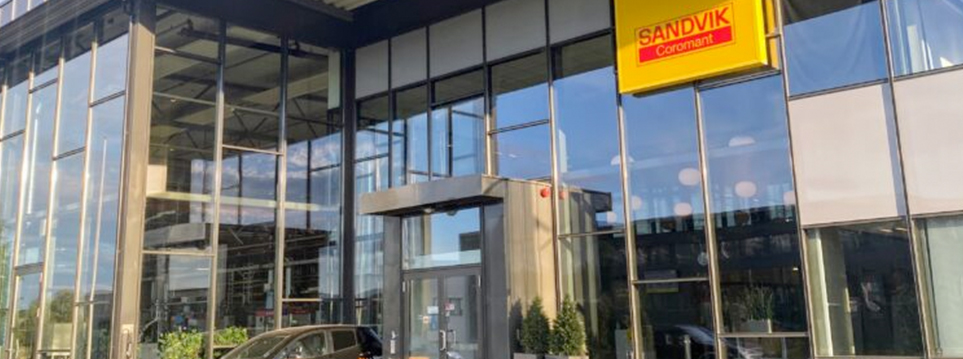
In 2008, Teeness moved into a new building in Trondheim and was bought by Sandvik Coromant, a company with which it had cooperated strategically since the 1970s. It is a thriving business, currently known as Sandvik Coromant Trondheim.
THE LEAN JOURNEY
One of the main misconceptions – and perhaps the most destructive one – about lean thinking is that it is all about process. What Toyota and other notable examples of lean companies (from Wiremold to Danaher) knew, however, was that if you do not have a product that sells in the market, it does not matter how excellent your operational processes are. Lean starts with creating value for the customer, and that happens when the best-quality product is in the customer’s hands at the lowest possible price. This key principle of lean thinking has always been a big part of Coromant Trondheim’s success.
Having said that, during a recent visit by the local lean community in Trondheim, Håvard Buhaug, site manager and general manager of Coromant Trondheim, told us that when the company first tried lean, they failed. The first mistake they made was to talk about lean and its tools without developing any understanding of the thinking behind it. Very quickly, Håvard had 100 employees armed with information they had gotten from Google knocking on his door to tell him in no uncertain terms that he was wrong about what lean is. The focus shifted from why and how to improve to the tools and techniques themselves, with the obvious conclusion that “it may work at Toyota, but it will never work here”. The confusion and arguments that followed thwarted any attempt to transform the organization.
Undeterred, the Coromant Trondheim management team waited for the next wave of corporate transformation, but this time tried a different approach. Instead of telling people to start with tools such as 5S, for example, they discussed ownership of the work and how the team could take control of their own processes, deciding for themselves how and where things should be. Along the way, they developed team autonomy, the problem that the 5S concept really strives to solve. Only when people saw the effect of their work and became curious were they pointed toward lean theory and concepts, so that they themselves could explore further how they could improve their own workplace.
EVERYONE IS A LEADER
It does not matter what position you hold at Coromant Trondheim, because the people-centered approach to manufacturing means that everyone is a leader. And because everyone is a leader, everyone has gone through basic leadership training. This means that everyone in the company has seen that leadership is really about finding problems, seeing opportunities in those problems and choosing one to explore further. The training also gave everyone a holistic view of the business and an understanding of how their work is connected to the big picture, which helped people develop their ability to choose the right improvement opportunities and the right problems to solve. At Coromant Trondheim, it is about making choices, evaluating the results and learning, so that the next time an opportunity or challenge comes up, people react in the best possible way for everyone and in the interest of the business as a whole. This capability has given everyone a greater sense of responsibility and more authority, which, in turn, gives the organization a lot of power to improve the work and keep its daily promises to customers.
ADAPTING WITH TECHNOLOGY
Another example of how lean thinking has slowly made inroads at Coromant Trondheim is the new fully automated assembly line. It was designed, developed and installed by an in-house team made up of a mechanical engineer and a few automation mechanic apprentices. Unfortunately, we cannot go into much detail about the inner workings of the production cell, but the results were extraordinary. The cell was able to process in just four hours what previously required a week of production, assembling many different products on the same flexible line with little or no changeover. This shows us once again the power of just-in-time thinking.
It was also impressive to see how all their machines were set up for easy maintenance and changeover and how there were few oil spills, despite the amount of machining equipment the company had. The factory was extremely clean, with a very pleasant working atmosphere – very different from some of the dirty and messy machine shops this author has seen during his lean travels. At Coromant Trondheim, there is a general understanding that the whole is the sum of each individual’s contribution, and a commitment to preventing rather than correcting. The easiest way to get a clean and organized factory is to avoid messy processes and leaks in the first place, making sure you only have what you need readily available (and perhaps the most important, and perhaps forgotten, part of 5S – team autonomy). When operators deeply understand the process, can also explain why they do what they do and own their own process, 5S is just a reflection of that ownership. At Coromant Trondheim, this ownership was further highlighted by the biweekly “captain’s round”: in it, a forum of operators walks through the factory to discuss health and safety with each station and each team and to look for ways to improve safety, quality and flexibility at every step.
Just-in-time thinking was also on display in their innovative use of Autonomous Intelligent Vehicles (AIVs). They are actually Intelligent, rather than Guided (AGV), Vehicles, because they can figure out on their own which path to take when transporting materials to different workstations, as needed and in the quantity needed. If, for some reason, something is blocking its path, the vehicle simply tries another route until it successfully reaches its destination.
DEVELOPING A SMARTER, GREENER PRODUCT
Although the factory was impressive, what was even more impressive was how well production and product development cooperated. R&D engineers spent a good deal of time talking with operators during the development of new products, a very different situation from the usual “throwing it over the wall” type of cooperation. When production and R&D are under the same roof, it is easier to include all the steps in a product development project. To emphasize and encourage collaboration, Coromant Trondheim placed the designer’s PC close to the machines that will produce what is being developed (usually just a few meters away), which makes it completely natural for people to meet with the operators and talk. Both the developer and the operator share a common interest in making sure that the new products being developed can be produced in a rational way.
So the company has removed every barrier that can be removed, or at least minimized its impact as much as possible. If physical separation is necessary, it is not a solid wall but a glass one. A good example of this thinking is that the coffee/tea station is located in the production area – a small but meaningful contribution to creating a common center in the operations. The short distance between engineers and operators makes it easy to discuss technical solutions that affect production processes or a prototype to be produced… all while enjoying a good cup of coffee.
THE ROAD TO GREENER PRODUCTION
So, what is next for Coromant Trondheim? In addition to a name change (did you notice?), they are now taking on the sustainability challenge of creating meaningful jobs in a green factory. For the next five years, they have charted a path toward the ambitious goal of eliminating or replacing all hazardous materials, using 60% solar energy, reusing their damping mass and carbide reinforcement parts, and collecting and using rainwater and melted snow. They want to become a certified Green Factory. Whatever challenges Coromant Trondheim may face in the future, one thing is certain: it will take rolling up their sleeves to find ways to overcome them. The kaizen spirit and respect for people are alive and well at the company as it moves from challenge to challenge, leveraging the power of its people.