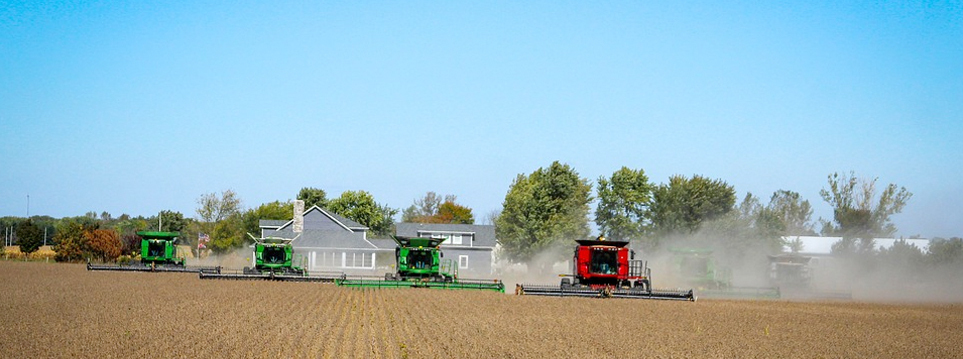
Examples of Lean Logistics in Agribusiness


Finding ways to make agribusiness more efficient, less harmful to the environment and more productive at lower cost is a human and global issue that calls for conscious initiatives. The use of lean in this sector has been gaining more and more ground, and many have already seen cost reductions, shorter process times and other gains from implementing lean in the field.
Lean applications in the inbound and outbound operations of farming and livestock businesses exist and are practiced, but since they require coordinating efforts among several agents in the chain, including producers, carriers and other third parties, it is recommended to start learning how to apply lean in agribusiness with internal logistics activities. That is why this article discusses two cases that focused on internal logistics, with two emblematic examples from Brazilian agribusiness: the grain-producing farm and livestock farming.
Example 1: Parts and services logistics
When we talk about logistics in the agribusiness sector, it is inevitable that our minds turn to vast areas and landscapes of productive fields stretching to the horizon, often far from urban centers. This reality, however, brings countless problems and difficulties to farms and producers when it comes to the logistics that their activities demand. Long times and distances are needed to move and transport products, information, machines, inputs and parts, which raises total costs and reduces productivity at important moments such as harvest, for example.
Many rural properties are located some distance from the nearest town, sometimes one or two hours' travel from the urban area. That is where parts are taken for repair when the farm workshops are not equipped for the work needed. All kinds of service providers and inputs that farming and livestock activities need in order to happen also come from the towns.
When we are at the gemba, it is not unusual to see situations in which the farm manager is absent because he had to “go to town to pick up a part”, or to find the operation stopped while it “waits for the supplier to make the delivery”. Scenarios like these are quite frequent and have an enormous impact on productivity and production costs in general. Stopping a harvesting, planting, feed supply or soil preparation process for a few hours can mean heavy losses in the final result of the processes. In addition, they constantly drain resources (human, financial) from the core operations of the business.
Sometimes two or three trips a week are made to the nearest town, buying and acquiring “one-off” products, usually on an emergency basis. But lean thinking offers some possibilities to help minimize (if not completely avoid) the impact of this kind of event on farms.
A first point to highlight is that emergency purchases and freight usually cost more, since they prevent the purchasing department from having enough time to quote and negotiate properly with suppliers. Moreover, it is not unusual to see highly technical resources (such as the manager, the agronomist, etc.) acting as carriers and delivery people.
There are some opportunities here for us to think lean:

- Reduce emergency purchases through planning of replacement items, planning of scheduled purchases, inventory management and insourcing of services through internal training.
- Manage machines and equipment with a history of the items and parts that need to be in stock to be replaced when necessary (components such as fuses, lubricating oils, pins, bolts, tires, batteries, belts, bearings, starter motors, among others, can be highlighted here). Obviously, keeping every possible item in stock generates a high cost, but by surveying wear items and preventive maintenance, the items are identified . Therefore, good management of spare-parts inventory can avoid countless emergency trips.
- Schedule purchases by consolidating orders, making transport more optimized and implementing internal distribution routes for the items, so that employees do not have to leave the field to go to the storeroom.
- Insourcing services is also something to consider. Some repairs of machine parts, for example, could be done on the farm itself, if the maintenance team and operators had the capability to carry them out. Making shafts on a simple lathe, fixing a tire and doing a weld are some examples of jobs that may require transport to town, increasing the time activities are interrupted and the waiting on everyone's part.
- In the case of operators, having a basic “kit” of tools and components at hand can avoid moving the equipment to the workshop, reducing movement, fuel consumption and the time required. Training in basic maintenance is always welcome. Another solution adopted in some cases is the mobile workshop, usually fitted onto the bed of a light cargo vehicle so it can travel more quickly to the equipment that needs repair.
Another major logistics problem faced on farms is the transport and movement of machines and equipment to distant areas of the properties. Often, for a machine to go from the shed to the area where it will operate, it must travel dozens of kilometers, taking up to one or two hours (slow-moving vehicles). There are some factors that make this scenario even worse: the infrastructure itself of roads, gates, bridges and embankments can affect and hinder this transport between field plots, for example. Sometimes it is necessary to load the machines onto trailers to take them from one production area to another, and the effects are damaging to deadlines, costs, safety and, ultimately, competitiveness.
Once again, lean thinking can help in some of these situations:
- Planning and preparing activities in advance.
- Sequencing planting and harvesting “in optimized routes” to avoid empty trips.
These are just a few examples of how thinking lean can help reduce logistics costs within farms. If we take into account the stages of grain storage, animal loading and transport to urban centers and agro-industry, the opportunities are even more numerous.
With lean in logistics, we avoid waiting, queues, rework, extra freight, emergency purchases and other associated waste. Simple concepts (but effective ones, which need to start with critical thinking and the attentive eye of everyone on the farm) can make a big difference.
Example 2: Logistics of a feedlot

In agribusiness, it is very common to come across hectic days, busy routines and the good old, famous “firefighting” management. With all this, a lot of waste and expense accompany this famous style of management. This is especially present on a cattle feedlot farm, where we observed an interesting case of lean application.

As we can see, above are the main cattle feedlot processes at a macro level. Logistics is present in each of these macroprocesses, and the lack of management leads to major waste. At this point, lean has great potential to help, as can be seen in the situations below.
1. Receiving animals for processing and shipping to the slaughterhouse
This is a very important stage in the cattle feedlot process, because it is at this moment that animals bought from small producers arrive at the feedlot and go through processing, where vaccine health protocols and traceability protocols are carried out. Since these are live products, poorly planned logistics leads to significant losses.
An animal can lose around one to two arrobas (that is, 15 to 30 kg) during transport. Multiplied by the number of animals (which sometimes reaches 100,000 head), this can result in an enormous loss; therefore, applying lean concepts is essential.
It is very common for trucks to arrive after office hours and have to wait until the next day to be checked into the feedlot farms. When it comes to live cargo, this causes an enormous loss and must be handled differently.
By implementing some lean concepts and tools in the process, we observed improvements on the farm in question such as: a reduction in the time to receive animals at the feedlot from an average wait of five hours to 30 minutes; standardized transport schedules and maximum number of animals per truck to ensure reduced stress and animal welfare; implementation of the FIFO concept for received animals; proper handling and immediate availability of water and food for animals just arrived from travel; standardized work and operating procedures; design of a help chain process, among others.
Receiving and shipping animals must be done in an agile and planned way, because it represents an enormous potential amount of money that can go down the drain. Reductions in weight loss of up to 20% have already been observed with lean.
2. Housing the animals in the pens
This stage is the moment when the animals are assigned to and housed in their feedlot pens. The less handling is done, the better the performance and the lower the level of stress, weight loss and accidents with the animals.
On the farm in question, this stage of the process has five feed preparation and distribution trucks, an average of 100,000 animals in confinement and feed distribution four times a day. During the mapping of opportunities and waste, through measurements and data collection such as a spaghetti diagram, time studies and DNA analysis, we noticed large and frequent logistics rework, with trucks constantly maneuvering, rework and non-continuous feeding; in short, a tremendous back-and-forth to distribute the feed.
Among all the opportunities identified (such as assigning activities to drivers according to the best logistics and standardized work), the biggest result was organizing the animals in a standardized way, housing them according to their type of diet. We called this project the kaizen of sectorizing animals by diet, and it resulted in a gain of five minutes per feeding, going from 25 minutes between loading and distributing feed to 20 minutes. The gain seems relatively small, but when we multiply 8 trucks x 5 minutes x 17 distributions along the lines per day, it adds up to 680 minutes per day (or 11.33 hours). All of this freed up one truck, that is, an investment of approximately R$ 1.2 million, not counting maintenance, diesel and other expenses that were not accounted for.

3. Loading the feed trucks with the ingredients for distribution
For feed to be distributed to the animals, a few stages of feed preparation and mixing are needed. This process has an internal logistics route, along which the trucks move through the flow, receiving the ingredients and mixing them in the trucks' own mixer wagon. Each feed must be positioned strategically, thus ensuring shorter loading times and less waste in terms of input transport by the mixer trucks.
In this process, through the analysis of waste and opportunities, together with the team of truck operators and input process operators, we arrived at a leaner layout, which reduced the time for loading plus feed distribution from 20 to 15 minutes. The time saved generated savings of R$ 300,000 / year, which is exactly the cost of renting a wheel loader that was no longer needed. We applied concepts such as external input preparation (that is, preparation during idle process times so as not to affect productivity), and the inputs were rearranged sequentially to save movement and make logistics leaner. The improvements can be seen in the images below:

***
These are some examples of how lean thinking applied to agriculture and livestock farming can bring significant gains. The purpose of this article is to inspire readers to follow the steps described here and try to achieve the same gains (or others, adapted to each context) in their own efforts. Lean spreads mainly through the sharing of experiences, and the successes shared by the community can be the driving force behind new cases, making the world ever leaner.