Kaizen week drives quality improvement at a medical equipment company
Laerdal Medical's lean journey is about more than just productivity improvements – it is about “helping save lives”. Over the last three generations, the Laerdal family has led the company, headquartered in Stavanger, Norway, through its transformation from a local publisher of children's books and maker of plastic toys into a global organization specializing in medical training equipment and simulators – with factories in Norway, China, the US, and Mexico.
Since the early 2000s, lean and continuous improvement have been one of the pillars of their development strategy and have helped them keep producing cutting-edge simulators in a region known mainly for its oil and gas industry. In other words, they have been able to thrive in a high-cost city in a high-cost country.
As lean practitioners know all too well, sustaining the energy needed to continuously improve is probably one of the biggest challenges a lean organization faces, as leaders, managers, operators, tools, methods, and management fads come and go while the pressure to deliver is constant. So how do you sustain and nurture the kaizen spirit in an organization that spans three continents and employs a few thousand people? This is a question we have asked ourselves repeatedly in recent years.
The beginning
The first time Laerdal Medical's managers and employees came into close contact with lean thinking was during a consultant-led implementation in 1998. However, as often happens in such cases, as soon as the consultants leave, the tools and systems they had put in place start to wear down, and in due course the company is back to square one. A few years later, they tried again. This time, they focused on implementing 5S. Their first real breakthrough, however, came when the Stavanger factory began experimenting with just-in-time and quality improvements. Over a few years, the factory's leadership team managed to double productivity and cut the cost of scrap by 75%, while also interacting with the product development department to fix design problems in the products they were making in Stavanger at the time. The last major improvement they made was halving the square meters needed to produce their SimMan line of high-end simulators.
In the spring of 2018, Torbjørn invited a lean expert to the factory and asked for an honest assessment, and that is exactly what he got. “It's obvious you don't care about quality and you don't have a strategy for people", was the blunt but sincere feedback he received. Laerdal had always cared about the quality of its products and had always been an attractive workplace, so it was not clear to them what the sensei was saying.
In lean terms, caring about quality is the starting point for finding problems, which are the raw material for developing people. So Laerdal began a new chapter in its lean journey by involving the product development teams in monthly meetings in the obeya to analyze and discuss quality together. Defects, production problems, and problems with supplied parts became the focus of these conversations.
Just as this important work was beginning to bear fruit, Jon Åge Bergsagel-Larsen, value stream leader for the highest-turnover product lines and the instigator of many successful lean initiatives at the Stavanger factory, was sadly diagnosed with cancer; shortly afterwards came Covid, forcing everyone to work remotely and effectively halting the collaborative work between production and product development. Torbjørn and the other value stream leader, Hjarle Hagland, were overwhelmed with Covid-related work, and continuous improvement efforts began to run out of steam. The kaizen spirit was slowly fading away.
Gemba-based leadership development
Determined to revive the spirit, Torbjørn (who had just been appointed vice president of manufacturing and supply chain) and Hjarle (who replaced Torbjørn as plant manager in Stavanger) weighed their options. In the end, they felt that what was needed to bring the kaizen spirit back was an investment in people and, more specifically, in the factory's middle managers.
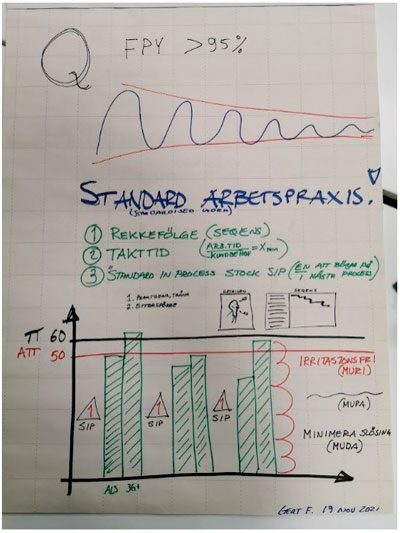
After reading about the leadership development program Gert Frick had developed at Volvo Cars, they contacted Gert to ask whether he would be interested in running a similar training program in Stavanger. The aim was to remind people of the importance of improvement work, train the factory's management team in the Toyota Production System, and rekindle the kaizen spirit in every participant. The first students on the list were Torbjørn and Hjarle themselves. The goal was to uncover and fix quality problems in order to raise first-pass yield to 95%. As the assembly process is almost entirely manual, it made sense to study the precision of manual work with the classic tools of standardized work – the foundation of TPS.
Day 1 – Be the change you want to see
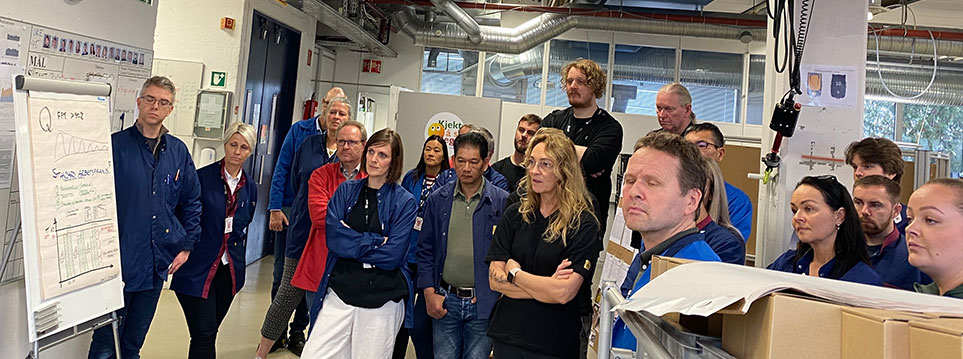
“To develop others, you must first develop yourself” sounds like something Myagi-san would say. But for people like Gert Frick, who trained and learned directly from Toyota sensei, this is the essence of lean. Lean is, first and foremost, a leadership transformation. Organizational transformation stems from the personal transformation of the leaders in an organization. And as our Toyota sensei taught us, you can only really learn lean by doing. So, after a brief introduction to the basic concepts of TPS, the students – 12 managers from the Stavanger organization – teamed up with an operator and were sent to study the value-creating work in the gemba. After a while, the students were asked to identify instances of muri (overburden) in the process, and a chart was created to track the problems found, the countermeasures taken, and the problems solved. Observation training continued for the rest of the day.
Day 2 – Problem identification, problem solving
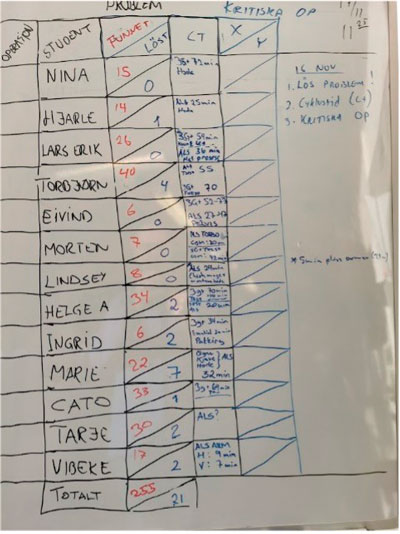
After a morning reflection on the first day's activities with the operators, the managers (or students) went back to the shop floor to continue their study of value-adding work, with the task of solving as many problems as possible for the operators along the way. During the day, big and small improvements were made. Some were implemented immediately, and others were discarded or rethought based on findings made during testing. In other words, the students were practicing PDCA. In one case, an operator and a student reorganized the packing area, getting rid of an unused solvent booth and moving some small machines so the operator could work in a smoother flow. Even Gert and Eivind got involved when a small computer desk was replaced with a larger one. Other minor improvements, such as new tools and jigs, were also tested. After the second day, many new problems had been uncovered, and some had been solved.
Day 3 – Takt production, a leap of faith
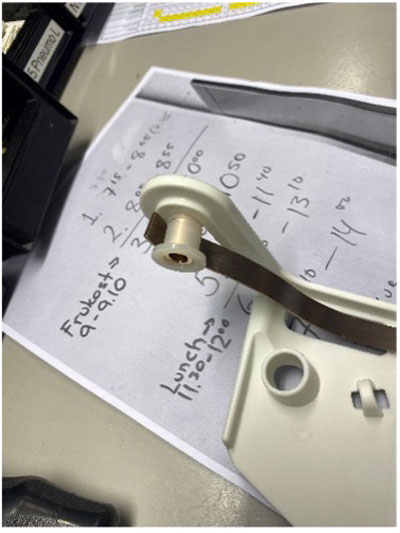
The original plan was to start takt production on day four. However, this was brought forward by a day so they could run the full sequence of a takt as many times as possible. After all, we are talking about a takt time of 50 minutes. An expected stock shortage meant we could only produce the easiest of the three main models, and it immediately came to light how unbalanced production was. After a few repetitions, Gert and the students, together with Mattias, the team leader, went to the Yamazumi board to rebalance the line. Going back to their expert operators, the students continued to solve problems on the line. They also started a discussion about the critical operations within each subassembly (something critical for quality and with a high level of difficulty) and how much standard work-in-process inventory was needed at the end of each line.
Day 4 – Mixing it up
Restarting the training at 7 a.m. (the same time the operators came in to work), the students had 15 minutes before the first takt began to reflect on the previous day's learnings. After some teamwork inspired by the purchasing and distribution teams, the parts were obtained so the students and operators could test the most advanced product in takt. As expected, the workload in some of the subassemblies meant that cycle time exceeded takt time by up to 30 minutes. That is not something you can simply solve with kaizen. Once again, this led to a discussion about balancing between Hjarle, the plant manager and interim value stream manager, and Mattias, the team leader. The students continued their problem-solving efforts and began summarizing their learnings on large cardboard posters.
Day 5 – What comes next?
The last day of the kaizen week began with a brief round of reflection and three production runs in takt. Afterwards, everyone gathered for a quick final discussion, during which Gert talked about the potential for the future. The day ended with each student presenting to the others what they had learned and what they would take forward. Finally, Gert and some of the students presented their findings to the other senior managers at Laerdal Medical.
Moving forward
Arguably, the hardest and most elusive part of lean is nurturing the kaizen spirit and finding the people who get a sparkle in their eyes when improvements are mentioned. Yet this may be one of the most important jobs senior managers are called on to do: finding and promoting people who have the energy to lead improvements and who can support the kaizen spirit. Another important management issue, which always needs to be addressed, is real and voluntary participation in quality improvements. This, combined with critical root-cause problem solving, is how we develop people. Finally, if you move toward greater precision with takt time, you must also push leadership to move from the traditional chain of command to a chain of help. If you are not ready to take this crucial step of true support, you will never achieve such a big change; instead, the fluctuations of normal variation will keep acting as a pressure release for the production line. If you follow this path of the kaizen spirit, you will discover problems and business opportunities you did not even know you had. Are you ready to take the next step?